
Orientation – some recent personal anecdotes and thoughts about AI In May our reunion of H-Star academic collaboration between Stanford and Denmark prompted me to reflect upon AI in research collaboration [Link]. A new white paper from Stanford’s Accelerator for Learning — Responsible Assessment in the AI Era — prompted me to comment that we…
science studies
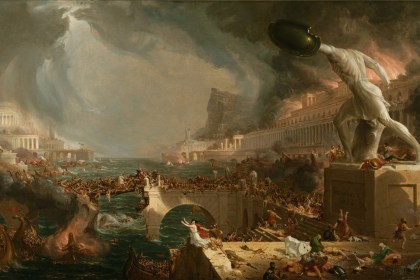
Nolan’s Odyssey (3) — the collapse of civilization and the shape of history
Performing the archive — a study in theatre/archaeology In July I posted a response to Nolan’s Odyssey [Link] — an old story, I argued, but not the one that was being talked about. The movie faithfully restages not Homer but a nineteenth-century grand narrative of civilization and its fall. A month of reviews and a…

Anatomy Galaxy — epistemic environment
An invited response to a one-day installation event – Anatomy Galaxy, by Connie Svabo.University of Southern Denmark Odense June 24 2026. [Link]Link to Connie Svabo’s dissertation on the project – [Link] Epistemic environments Connie Svabo’s Anatomy Galaxy began with a found situation: a decommissioned anatomy learning environment at the University of Southern Denmark — a wet specimen…

Newsletter — Stanford Archaeology Center
Prospective reflections on 2025-26 Acting with nature — prehistory My new book Archaeologies of Nature: Activating the Archive, written with Gabriella Giannachi, University of Exeter and Turin, is now complete and in production. Open Access — it will be available as PDF in June 2026. We use an archaeology of artworks to probe human relationships…

AI and collaboration — lessons from Stanford
Here is the keynote I presented at our reunion last week in Odense, of Danish alumni of the Stanford H-Star fellowship program (2010 to 2015). Keith Devlin (H-Star director emeritus) and Connie Svabo of the STEM Education Research Center – FNUG at University of Southern Denmark [Link], were our hosts. The program enabled about 50…

Science Learning – a future
I am in Copenhagen at the annual meeting of the European Science Education Research Association ESERA [Link]. Here is my summary statement for our plenary session that introduces Creative Pragmatics as a framework for reshaping science education [Link]. The world our students face today is not stable, predictable, nor neatly divided into disciplines. It is…