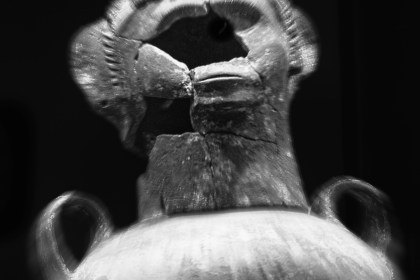
Burial urn. Etruscan 7th or 6th century BCE. Glyptotek, Copenhagen.
memory practices

Fogo Island — field notes on design, place, community
I have just returned from a fascinating gathering on Fogo Island, Newfoundland, Canada — Shore Time [Link], organized by Fogo Island Arts, a part of Shorefast [Link], the social enterprise founded by Zita Cobb in 2006 to build economic and cultural resilience on the island. Speakers and hosts were Kitty Scott, Leonor Antunes, Tom McDonough,…

Palmyra in the (archaeological) north
More legacies of antiquity, reworkings of what remains. Displacements. Funerary portraits. Loss and the burden of interpretation. I have been posting some photographs of statues from the extraordinary collections in the Glyptotek in Copenhagen. The museum also holds a large collection of funerary reliefs from ancient Palmyra, the oasis city in Syria that once served as…

Welsh memories in a Cretan landscape
I am on a short visit to Crete. Elounda, Lasithi. Out east. Past the prehistoric ruins of Malia, to where Chris (Witmore) and I drove in the Renault convertible on an impromptu photo shoot. It’s been twenty five years since. Another visit now to liquid commingling times. A dappled landscape I look out over a…

Heritage — making futures
A critical-heritage complement to the Janus Maneuver – [Link] More notes on futures studies. A second component to the same conclusion: that working with the past is a way of making futures. Convergence — the “Janus Maneuver” and heritage futures In a recent post I made the case for “The Janus Maneuver” [Link] — that…

Some archaeological notes on futures studies
The Janus Maneuver Hindsight, foresight, and futures studies Everyone, it seems, is a futurist now. Here are some loosely gathered thoughts on why an archaeology of design may be a missing foundation. These are notes – so expect inaccuracies and mistakes of memory (hopefully minor). After Janus – the divine principle of looking both back…