
Assessment in the AI era: a moment we have been preparing for since the 1980s A comment on the Stanford Accelerator for Learning white paper “Responsible Assessment in the AI Era” (2026) Quick summary — AI is revealing the flaws of traditional pedagogy based on standardized testing of final course deliverables. I am not alone…
creative pragmatics

Some archaeological notes on futures studies
The Janus Maneuver Hindsight, foresight, and futures studies Everyone, it seems, is a futurist now. Here are some loosely gathered thoughts on why an archaeology of design may be a missing foundation. These are notes – so expect inaccuracies and mistakes of memory (hopefully minor). After Janus – the divine principle of looking both back…

Newsletter — Stanford Archaeology Center
Prospective reflections on 2025-26 Acting with nature — prehistory My new book Archaeologies of Nature: Activating the Archive, written with Gabriella Giannachi, University of Exeter and Turin, is now complete and in production. Open Access — it will be available as PDF in June 2026. We use an archaeology of artworks to probe human relationships…

AI and collaboration — lessons from Stanford
Here is the keynote I presented at our reunion last week in Odense, of Danish alumni of the Stanford H-Star fellowship program (2010 to 2015). Keith Devlin (H-Star director emeritus) and Connie Svabo of the STEM Education Research Center – FNUG at University of Southern Denmark [Link], were our hosts. The program enabled about 50…

Digital Humanities — a zombie concept
This is part of my long-running commentary on the current state and future of the humanities, including what gets called digital humanities. Nudged by a symposium at Stanford There was a symposium at Stanford last week (November 14-15) called “The Futures of Antiquity in an Age of Digital Data and AI”. Credit goes to faculty…
Deep Mapping
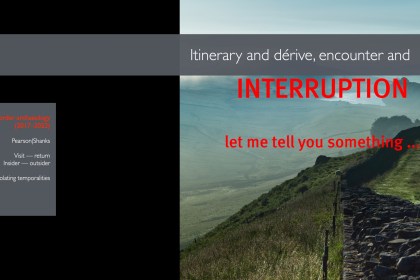
I’m in a workshop about Deep Mapping, delivering the opening keynote. A fascinating gathering (Venice and online), organized by Cristina Manzetti (University of Cyprus), and Valentina Mignosa (Ca’ Foscari University of Venice, Digital and Public Humanities (VeDPH). The topic is an old favorite of mine, developed in my theatre/archaeology with Cliff McLucas and Mike Pearson…