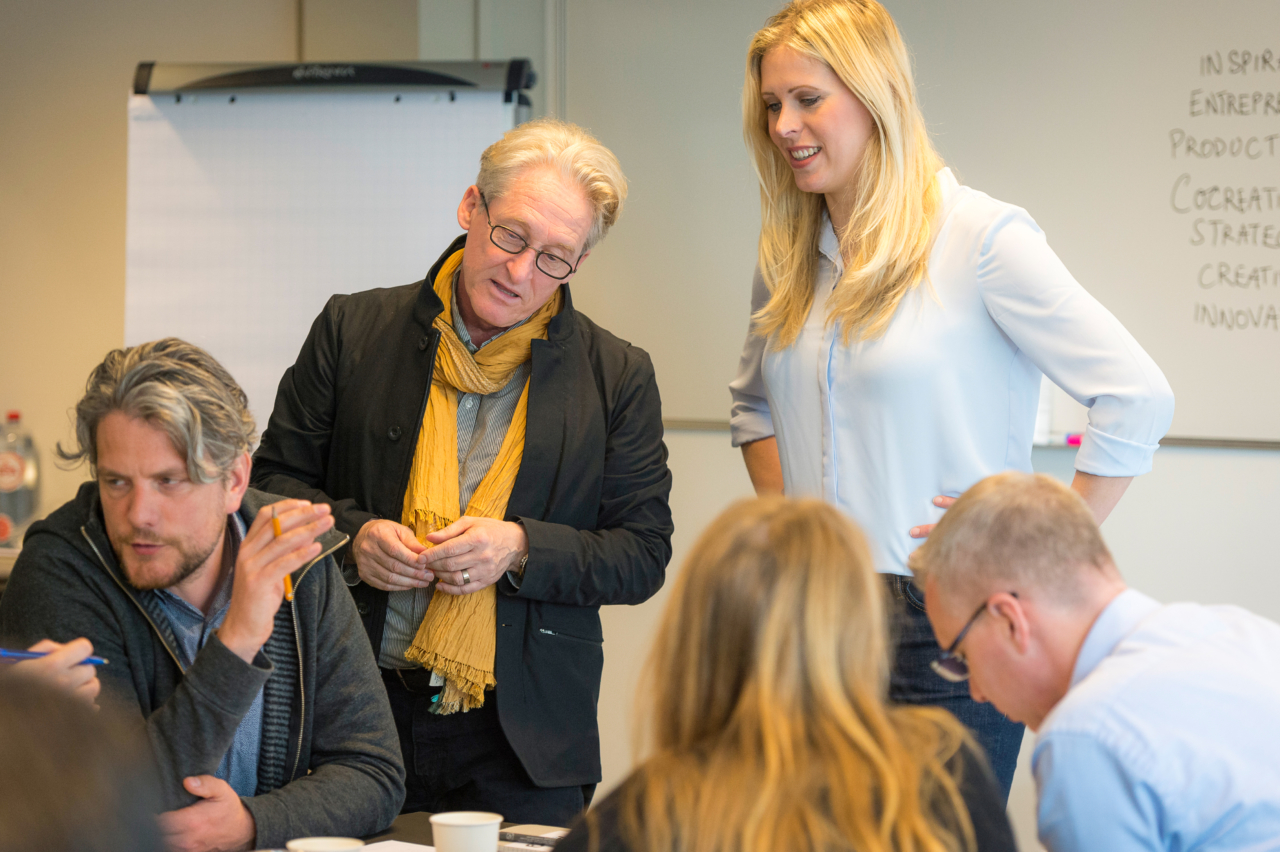
Here is the keynote I presented at our reunion last week in Odense, of Danish alumni of the Stanford H-Star fellowship program (2010 to 2015). Keith Devlin (H-Star director emeritus) and Connie Svabo of the STEM Education Research Center – FNUG at University of Southern Denmark [Link], were our hosts.
The program enabled about 50 scholars from Denmark to spend a few months with us at Stanford in what turned out to be a remarkably successful exercise in research collaboration and exchange. So much so that about 25 thought it worthwhile to gather to look back at the experience and look forward to the future of research collaboration that crosses disciplinary and institutional boundaries.
My keynote offers an assessment of what H-Star, and its associated program mediaX, did, and then looks forward to the potential of AI assistants and agents to enrichen research collaboration and networks.
You can find more context in another post where I review H-Star and mediaX more generally – [Link]
The keynote was followed by a long discussion of what we recalled as the great features of our experiences through H-Star — experiences that we might take forward as legacies and lessons for delivering great research collaboration.
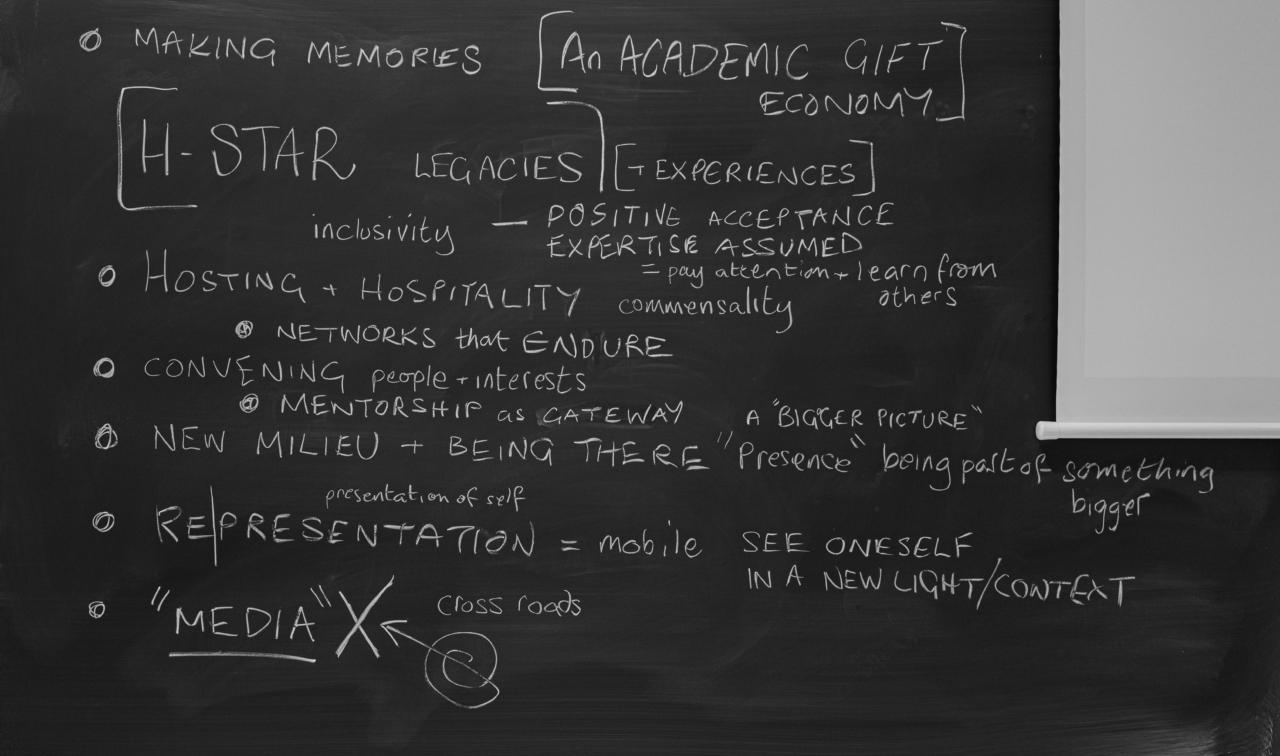
Here is the list we came up with:
An academic gift economy
HOSPITALITY – a culture of hospitality and hosting (one might call it commensality)
INCLUSIVITY – inclusivity and flat hierarchies – hosts and guests were assumed as equals in expertise and experience
PERSONAL GROWTH – visits to H-Star have played a key instrumental and inspirational role in personal development
CONVENING INTERESTS – a key feature of the fellowship program was convening people interests, aptitudes, experiences, aspirations
INTELLECTUAL CROSSROADS – both H-Star and mediaX were cross roads for people to meet new interests and make new connections
VISION alumni describe positive experiences of being part of a bigger project and vision than just a fellowship program
SELF-UNDERSTANDING – alumni found the program enabled them to see themselves in new and positive ways
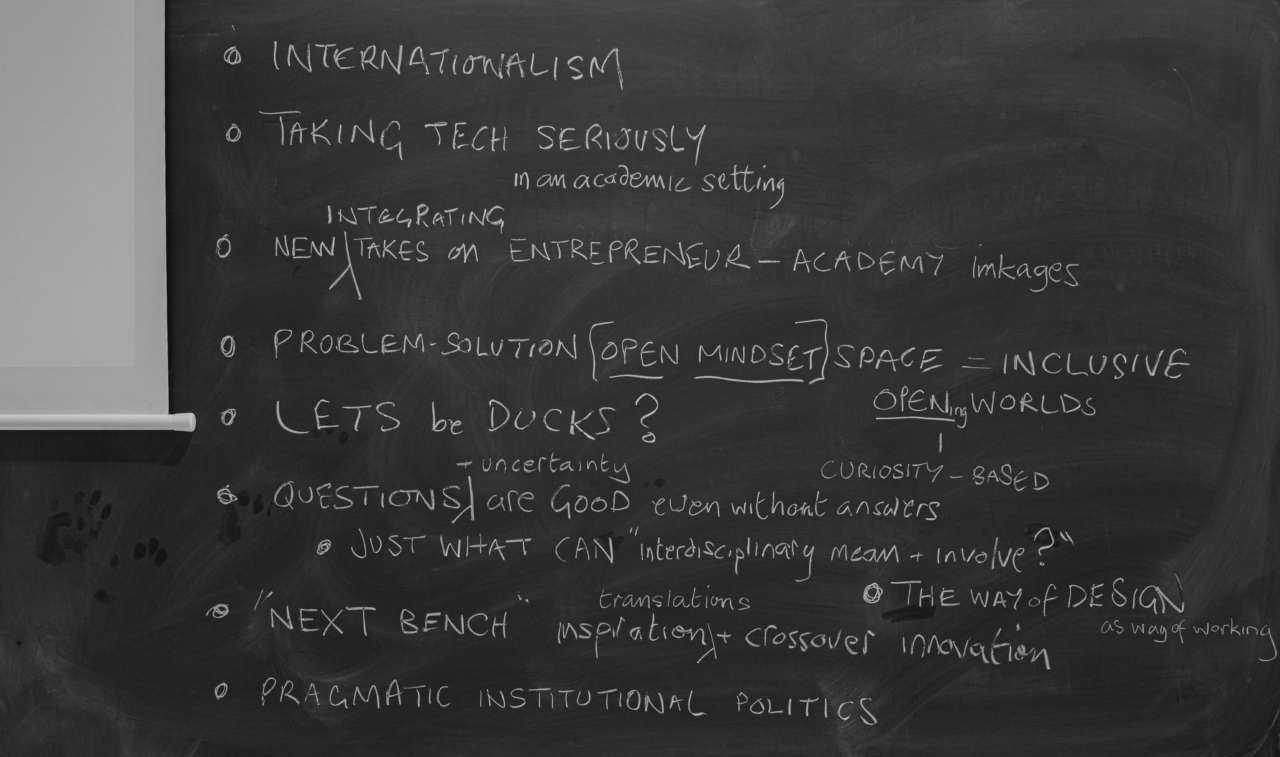
INTERNATIONALISM – genuine internationalism
HUMAN-CENTERED TECH – taking tech in research and education seriously (in an academic setting)
ENTREPRENEURSHIP – new and actionable angles on entrepreneurship in an academic setting
OPEN and GROWTH MINDSET – an inclusive and open mindset, rooted in curiosity, focused on problem-solution linkages and (transdisciplinary) matters of concern
TOUGH QUESTIONS FIRST – embrace of uncertainty and of questions that entail no easy solutions/answers
CROSSOVER INNOVATION – “next bench” experiences in research – crossover innovations/translations from one research field into another
PRAGMATIC “CAN-DO” PROJECT MANAGEMENT – finding pragmatic workarounds in complex institutional politics of the academy
The power of “THE WAY OF DESIGN” – embracing design-features such as context-specific research, experimental exploration, ideation, prototyping, iterative testing
Science Learning – a future
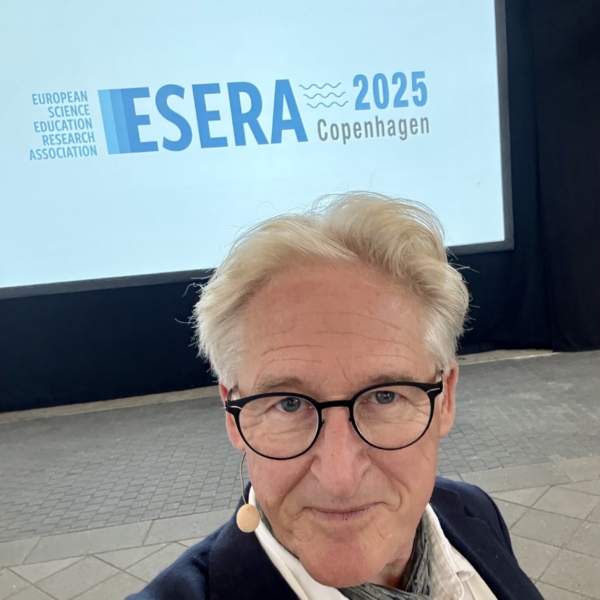
I am in Copenhagen at the annual meeting of the European Science Education Research Association ESERA [Link].
Here is my summary statement for our plenary session that introduces Creative Pragmatics as a framework for reshaping science education [Link].
The world our students face today is not stable, predictable, nor neatly divided into disciplines. It is complex, interconnected, and uncertain. Climate breakdown, technological disruption, social inequality — these are not problems that can be solved with technical knowledge alone. They require judgment, creativity, collaboration, and a willingness to act under conditions of uncertainty.
This is where our concept of Creative Pragmatics comes in.
My standpoint — an archaeologist, working in that most multi-disciplined, undisciplined of scientific fields. Exploring since the 1970s an archaeological engagement with the world where what one seeks to understand, the past, is actually all around us and in constant flux, where there is no “past as it was” to discover, where archaeologists don’t deliver knowledge of the past, but creatively work with what remains, with a care for the future.
An archaeologist in a design school, Stanford d.school, mobilizing research into the long-term history of making, design, innovation, as part of efforts to build better futures.
Creative Pragmatics is a synthetic framework for active learning-in-the-world. Its components are well-established; many will be familiar. Its novelty and value lie in what it assembles and gathers, how it does this, and in the consequent implications for action and policy.
CP builds on three foundations:
pragmatist philosophy from William James and John Dewey, through A.N. Whitehead to Richard Rorty — knowledge is something made through experience;
the field of science and technology studies — Isabelle Stengers and Simon Schaffer, Bruno Latour and Donna Haraway, Andrew Pickering and Annemarie Mol (among many others) — emphasizing the performative, dynamic, and material character of knowledge; raised are fundamental matters of ontology where we are part of what we seek to understand;
the praxis (informed practice) of art and design, project management from located and applied research to ideation, improvisation and prototyping to testing — iterative learning through making.
What unites these components in CP is a simple but powerful premise: knowledge is not discovered; it is created through doing and making. Learning happens not by receiving facts and applying standardized procedures, but by designing, experimenting, reflecting, collaborating — by engaging actively in and with the world.
So—why does this matter? Why Creative Pragmatics, and why now?
Because traditional models of STEM education are not enough. Too often, science is taken as if it offered stable truths. In a complex world, knowledge is only ever partial, contingent, evolving. Students need more than mastery of disciplinary content. They need the capacity to navigate uncertainty, to integrate different perspectives, to act creatively and responsibly in contexts where the stakes are high and the answers are not given.
Creative Pragmatics matters because it offers exactly this:
CP bridges the divide between sciences and humanities through making and design;
CP emphasizes agency — helping students see themselves not as spectators, but as participants shaping our world, where our agency is in symmetry with the non-human, where we are part of the ongoing coming-into-being of the world;
CP is situated — where the actuality of knowledge-making is a context-sensitive pragmatics;
CP aligns with global policy frameworks—from the European Qualifications Framework to the OECD’s 2030 competencies—that call for education to prepare learners for complexity, not just for exams.
So, what next? What does Creative Pragmatics mean for actual practice?
In the classroom, it means participation—from content delivery to active, student-centered learning. Project-based work, design studios, inquiry-based learning, phenomenon-based learning, and creative rehearsals all become central. Teachers are no longer transmitters of knowledge; they are designers of learning environments.
In the lab, it means that experiments are not just about testing hypotheses, but about making knowledge together — through collaboration, prototyping, iteration, and reflection.
And in policy, it means recognizing that innovation in education does not happen through standardized testing or rigid curricula. It happens through creating ecosystems that support interdisciplinary collaboration, experimentation, and adaptability.
All of these have deep tried-and-tested genealogies that confirm their renewed significance and urgency. In our CP research group, the Nordic tradition of student-centered learning meets Stanford’s design thinking — and much more.
If there is one takeaway from our book, it is this: there is no solid ground of science for science education to stand on. Scientific knowledge is time-bound — located historically, in the actuality of now, in iterative chains of projects. This contingency is not a weakness — it is opportunity. Science and technology can be reconfigured (they always have been), and education can help students develop the skills, competencies, and imagination to reconfigure them for the better. As Pickering puts it — acting with the world, not on it [Link].
That, in essence, is Creative Pragmatics: an invitation to rethink again how we build knowledge, how we learn, how we teach, and how we prepare students — not just to survive complexity, but to shape the future with creativity and agency.
Applied Archaeology — Applied Humanities
Studio Michael Shanks Stanford University
Newsletter 2024 Stanford Archaeology Center
Archaeological mission and vision? Ivory tower as lighthouse?
In a recent newsletter for Stanford Archaeology Center [Link] I talked of slow archaeology, of the benefits of long-running projects that afford time for unfolding reflection. Three interrelated projects remain ongoing. A kind of archaeological triptych.
— A prehistory of Graeco-Roman antiquity. Modeling: against narrative. An episodic and synoptic treatment of Graeco-Roman antiquity through scenario modeling. With Gary Devore.
— Theatre/Archaeology: Performing Remains. Pragmatics: against method. Case studies in performance design. With Mike Pearson.
— A Border Archaeology: northern margins. Trespass and transgression: against place. Archaeological itineraries in northern Europe.
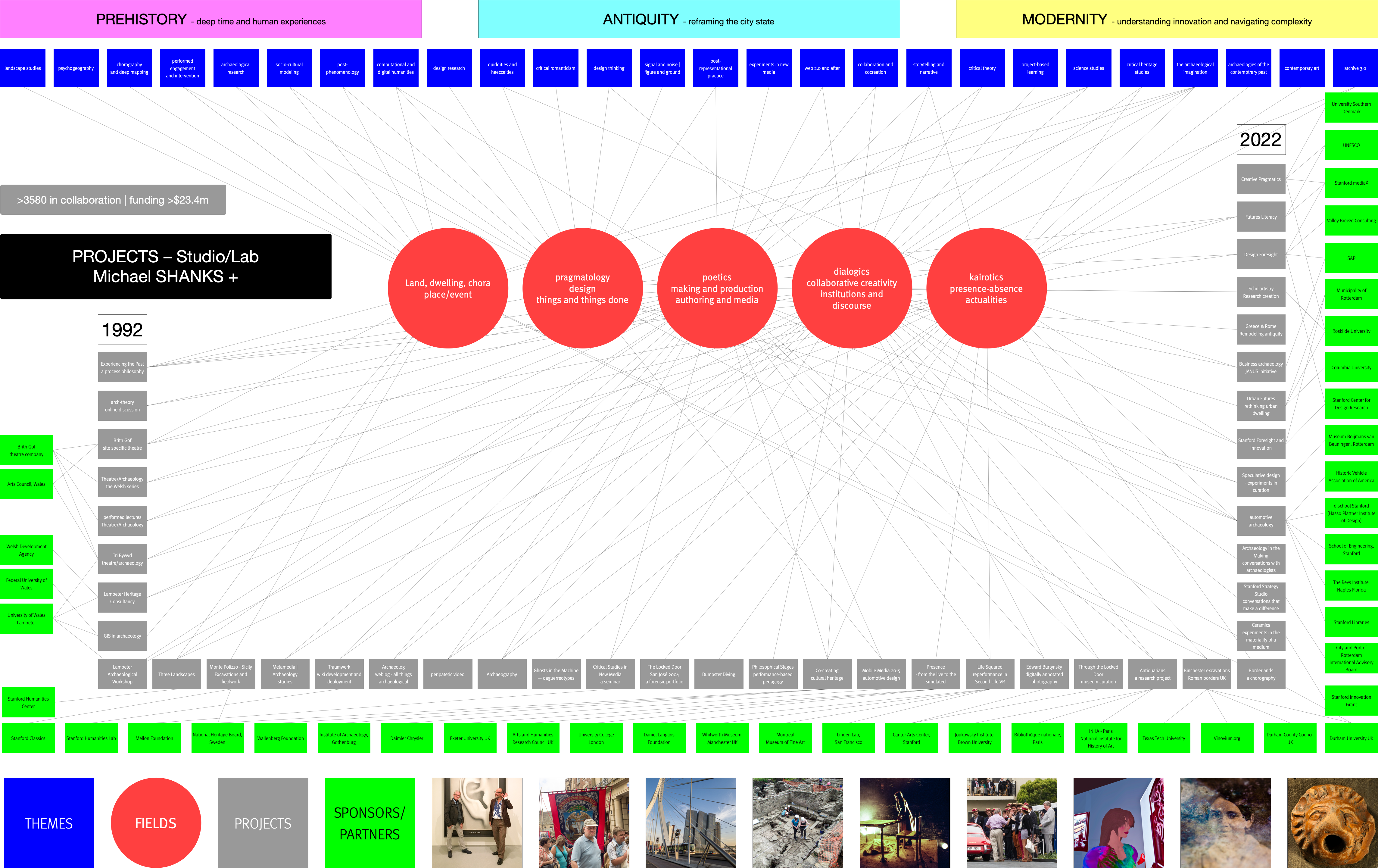
Fifteen years in the making, these projects in the archaeological imagination are a milieu within which I follow digressions and deviations to confront matters of common and pressing concern in publication, conversations, through conferences and symposia, in collaborative projects with colleagues in the academic and corporate world.
In another newsletter in 2022 [Link] I flagged up how I see archaeology to be less about the past-in-itself, and more about past-present connections. This is to see what we do as archaeologists as a kind of memory practice, with a percolating temporality of actuality, of present-pasts, and of kairos, the concept of opportune moment, that nudges us to be aware of the timeliness of our engagements with the remains of the past.
These standpoints and concerns came into much sharper focus this year. I have long spoken about applied archaeology; it is clear to me that such an archaeology-for-the-present-and-future is a model for a related field of applied humanities. Both involve a reanimation of what can be summarized in a concept of archive.
What has all this actually looked like?
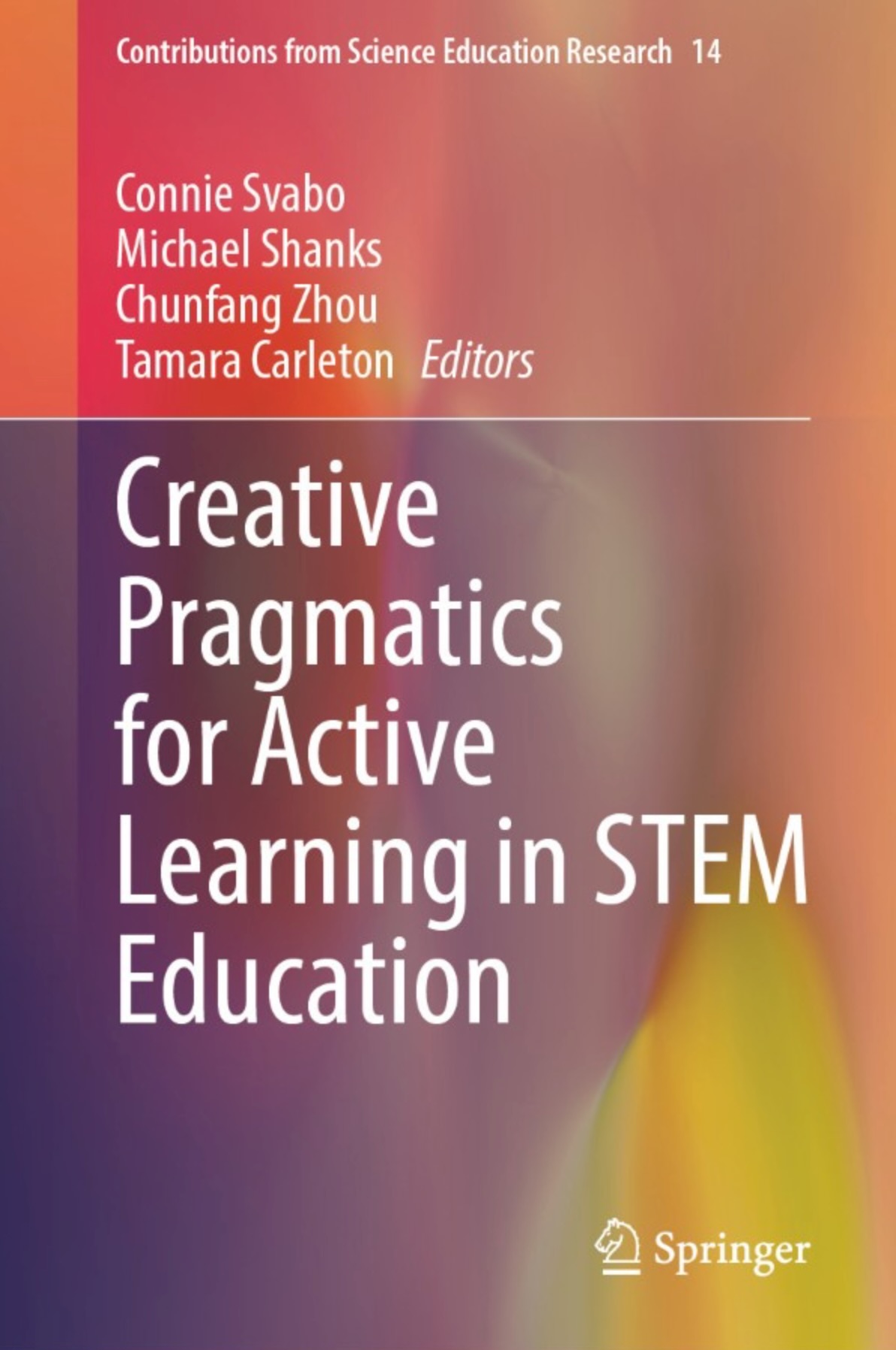
I find myself ever more deeply involved in projects concerned with how we share and learn skills and competencies oriented on future well-being. A book on such matters, Creative Pragmatics for Active Learning in STEM Education (edited with Connie Svabo, Tamara Carleton, and Chungfang Zhou) [Link] is receiving great responses. Projects focused on building communities of learning continue with the corporate world, in conferences and symposia, and in the discussions current in the research network that includes my studio/lab. A long investment in the archaeology of landscape is bearing fruit in a new book with Gabriella Giannachi (Archaeologies of Nature: from Landscape to Climate Breakdown) that mobilizes an archaeology of arts practices, from prehistory to contemporary art, to offer action-oriented responses to climate change.
Of note here is the ongoing collaboration with FNUG (Forskningscenter for Naturvidenskabelig Uddannelse og Formidling), the Center for Research in Science Education and Communication at University of Southern Denmark, directed by Connie Svabo. A shared interest is typically labelled impact — how the academy connects with society more widely. More than this, for me, the center is a hub of extraordinary transdisciplinary expertise and creativity that exemplifies the value of collaboration in scholarship.
More than ever it is clear to me that we cannot afford the luxury of hyper-specialized research. Better put — specialized deep knowledge must be accompanied by lateral address, collaboration and communication across disciplines. Such a disposition is captured well in the concept of the “T character”, where drilling down in research is capped by a capacity to connect (my memory tells me it was Tim Brown who introduced the concept in his book with Barry Katz, Change by Design, (2019) — the connection with design practice is appropriate, because the academy engineers knowledge).
What role for such an academic? What mission for archaeology? What vision for the future? In the ivory towers of academia? Of course the academic might hide indulgently and hope for protection in a precarious world. Or, rather, one might treat the tower as a protected viewpoint from which to make forays, to survey the world and offer commentary and critique, maps and directions — ivory tower as lighthouse. Applied archaeology, applied humanities — where the effectiveness and value of such wayfinding is not just short op-ed opinion, but interventions founded in high-quality scholarship.
(One also knows what happens when there are no stable beacons of navigation.)
In the wake
Between 1979 and 1993 I worked with Chris Tilley (Cambridge, Wales, and University College London) in studies of contemporary beer can design, prehistoric pottery and monumentality, heritage and museology, theory and method. Our books published in 1987, ReConstructing Archaeology and Social Theory and Archaeology, launched our academic careers and caused some commotion in archaeology.
Photo: Beer bottle design in prehistoric Sweden. Shanks and Tilley on the Øresund ferry in 1988. (Photo credit: Karin Tilley)
Tilley’s untimely death at the age of 68 in March 2024 prompted me to look back over his academic life [Link]. I must have spent a month rereading his books. I found myself following his ideas yes, but there was also a nagging question in my mind. How are we to value the life of an academic researcher? Does it lie in original findings? In the number of books, publications, citations? In the ideas? In academic memes and isms — fashionable phrases, concepts, approaches that catch on? In honors and awards made by the establishment?
Photo: Land and photo engagement. The chambered tomb of Orenäs, Sweden 1988. (Photo credit: Michael Shanks – from the Tilley archive)
Many have claimed to be influenced by Tilley’s phenomenology. My close rereading of his books led me to ask what this means. It is clear that Tilley’s work is indeed much cited, but rarely in any detail (I found only a couple of close engagements with his fieldwork). How much of his work is read? Many of his books are difficult to access. How long is to be the life of his books on the shelves of academic libraries?
There is an academic melancholy to this question. I am deeply fascinated by Tilley’s phenomenology and have a cherished and personal connection with his work. Yet I found it quite impossible to read the long descriptions of megalithic-encounters-in-the-landscape, of viewings of panels of rock carvings that feature so prominently in his books. I skipped over the detail. Maybe it was his style that didn’t grab my attention. Maybe there is a broader issue about academic writing, about reading and citation.
The percentages may vary (between 70% and 90% for the arts and humanities), but it is very clear and uncontroversial that most academic research is never cited (we might harbor hope that no citation does not mean no reading). Do we need the percentages? Witness the experience in any university library — the miles of academic texts, testimony to life sentences of academic labor, and most of which, yes, will be hardly read. Is this what we work for?
Bruno Latour made the case (in his Science in Action (1987)) that academic writing may seek citation, but is designed not to be read. What does this mean? Surely the job of academics is to write and read. One might challenge the assumption that close reading is the complement to academic writing if we acknowledge that the apparatuses of scholarship, including style and citation, work to assure any reader that they need not read too closely to accept what is offered in the way of synopsis and conclusions. In taking up an academic text one might note a tight style that anticipates questions and critique and offers sufficient qualification and conditional context (“only if these conditions are met will what is proposed be a candidate for approval”, for example) to justify a quick perusal rather than a close reading. I have suggested in a recent essay on social theory in archaeology [Link] that much academic debate is organized around summarizing labels (“isms”, positions, approaches, paradigms) that reduce and simplify, without the need for close reading and commentary. Tilley = landscape phenomenology, a development of post-processual archaeology. Period.
Another way of expressing this is to hold that what matters in the pragmatics of the academy is not so much what we write, but the way we act. This is more than McLuhan’s “medium is the message”; it is about the performance of scholarship.
Photo: Elk – ship – boot. The prehistoric rock-art site of Nämforsen, northern Sweden, in the wake, in the steps of antiquarian Gustaf Hallström. Tilley’s aesthetic in a river bed. August 1988. (Photo credit: Michael Shanks – from the Tilley archive)
Tilley’s was a life-long project in what we can call environmental aesthetics. Aesthetics, for me, is the key here. Value not in what Tilley said but in the ways he engaged with places and things, and with colleagues, friends, students, strangers. Tilley dealt in relationships with environment; respect and acknowledgement of diverse voices; developing secure foundations of knowledge, in experience, modes of engagement with the world, representation and report.
I attended a symposium at University College London in November 2024 [Link] to celebrate his life and work. Over and again one heard of his attitudes, manner, the way he worked and was part of institutional life, and his life beyond. Tilley was skeptical of too-easy answers delivered by institutional authority and reached out to everyone with infectious energy in an open invitation to seek authentic vital experience together. This is a most valuable legacy.
In a book of interviews with 20 or so archaeologists called Archaeology in the Making (edited with Bill Rathje and Chris Witmore and published in 2013) [Link], this key insight into the value of archaeological practice and experience was clearly affirmed. Do archaeologists dig up the past, create theories and follow methodologies in movements of ideas and accounts of the past? This is how most textbooks describe the discipline. Just as in my rereading and reflection upon the work of an archaeological friend, Chris Tilley, archaeology is much better understood as what archaeologists actually do — work with what remains in all sorts of ways, and as part of communities and institutions of learning.
The concept of archaeology
Our academic research communities today tend to be globally distributed, especially because of digital media. The extended research community to which my studio/lab belongs is much concerned with the concept of archaeology.
Bjørnar Olsen, a colleague from Tromsø in Norway, was back at Stanford in Spring 2024. We were working on this topic and here is a summary of what we are holding forth.
Archaeology is not history. While historians typically focus on how and why the past unfolded the way it did, archaeologists work with what remains. As a kind of genealogy, archaeology traces the connections that tie the past to the present while denying the historical continuity and linearity of an unfolding story. Emphasized instead are discontinuities, ruptures, as well as underlying energies.
Archaeology’s focus on remains makes central the concepts of archive and curation. Its methodology is concerned with how the past persists and returns, transforms and evolves, haunts and orients us in the now and for the future, as well as how we might deal with concern and care for those remains.
As a kind of memory practice, archaeology draws on the concept of memory found in Proust and Freud. In “rubbing history against the grain” we share much with Walter Benjamin’s opposition to historicism through his immanent materialist critique, his own kind of archaeology. There are affinities also with the genealogy and archaeology of Nietzsche and Foucault. Discourses, modes of production of knowledge, are characterized by discontinuities, matters of power and agency, and historical contingencies. By uncovering these infrastructures archaeology provides tools for critically remodeling contemporary values and practices.
Such an archaeological orientation aligns with cutting edge approaches in new materialist and pragmatist philosophies, science and technology studies, critical theory, performance studies, and media and communication studies. A comprehensive exposition of such connections can be found in Laurent Olivier’s wonderful book The Dark Abyss of Time: Archaeology and Memory (2011).
And such a concept of archaeology is intensely personal. Another death in summer 2024 was that of my father at 90 years. In hIs home of 47 years were gathered the things that accompanied him through his life, that he had selected, cared for, arranged and rearranged. A ship-model-in-the-making and yet to be realized, a care-worn garden with an old vine in a shattered glasshouse, a calendar of anticipated events on the wall, records kept of prescribed medicines, photos of moments spanning decades and many places, curated cared-for memorabilia, upcycled ships’ parts, a standard lamp of style circa 1960s, CDs and DVDs ranging in date of manufacture from the 90s to the present, in music and film from medieval to contemporary 2024. And more.The value, for him, in small things remembered. They bear witness — but not to any history, any coherent narrative — in small things forgotten. No history, but archaeology — yes. [Link]
Archaeologies of nature
Photo: Environmental aesthetics. How might an archaeologist visit an ancient shoreline? Photo Grid 17: Nyborg Strand (Fyn, Denmark) 2024 September 12 09.29.02 Central European Time. AI assisted amplification. (Photo credit: Michael Shanks)
Another collaborator of long-standing, Gabriella Giannachi, from Exeter UK, was in Stanford a couple of times over the year as a guest of my studio/lab and of Ng Humanities House, where I am resident faculty. As of the end of 2024, we have nearly completed a manuscript of a book, out now with Routledge for review for publication.
Here is a brief summary of the project.
Archaeologies of Nature: from Landscape to Climate Breakdown
In the contemporary concern about climate emergency, the science and policy, the pragmatics and debates, nature is a key concept. Implicated are matters of cognition and perception, how we think about and sense the world around us, matters of relationships and connections with other species and environments, of science and knowledge building, of action and impact, and deep existential questions of how we conceive of humanity itself.
In this book we propose a radical reexamination of the concept of nature, refreshing and renewing with a view to how we might act for the future. Artworks have long explored human relationships with nature. We engage with artworks, reframing key artistic practices that have involved the concept of nature, spanning prehistoric rock art, landscape painting, to activist contemporary art that deals with climate change.
Our approach and methodology are new. We present an archaeology of art practices. Ours is not an art history that tells a story of art and nature organized by date and movement. Instead, we take the past to be all around us, immanent in the present, just as what has happened geologically, in prehistory, in the past continues to be a fundamental part of what is happening now and offers orientation on future possibility and potential. Archaeology is a kind of memory practice. Through close and comparative examination, we animate an archive of artworks, prehistoric to contemporary, exploring the stratigraphic foundations of the present, and the energies and processes that have brought us to where we are and where we might go.
Thinking through artworks, treating arts practice as research, we show how the concept of nature is affiliated with environment, ecology, weather, climate, earth, dwelling, inhabitation in an expanded semantic field of complex living and adaptive systems. This foundation takes us beyond an arts-science binary into futures-oriented strategies and tactics.
We use an archaeology of artworks to refresh the concept of nature as an aspect of environing — the vital processes of our lifeworld conceived as a complex living adaptive system. Our archaeology reveals what is immanent, already present in our long inhabitation of the planet, as explored in artworks. In this we offer orientations, practices, policy, and a concept toolkit.
In the wake of Benjamin and Foucault we are reclaiming the concept of archaeology (just as Alfredo González-Ruibal would have us do in his 2013 edited book Reclaiming Archaeology: Beyond the Tropes of Modernity).
The book animates an archive of artworks. Gabriella and I have just been commissioned to write a book about archive, archaeology, and AI. Manuscript due end of 2026.
Photo: Archaeologies of nature. 古知谷阿弥陀寺 — Kochidani Amidaji Temple (1609) — north east of Kyoto. (Photo credit: Michael Shanks)
Pedagogies for the anthropocene
I have always treated pedagogy and the design of curricula and learning programs to be critically important. How might we make our learning more effective? Ready-to-hand and fit-for-purpose. Matters of inter-generational communication. Archaeology, an archetypal transdisciplinary field, simultaneously art, science, humanities, project management, cultural production, is such fertile ground for exploring and testing pedagogies that prepare us for the future in all its uncertainty and precarity.
Initial responses to Creative Pragmatics for Active Learning in STEM Education [Link] are very positive. The book is supported by ESERA (European Science Education Research Association) and the Novo-Nordisk Foundation (that funds much research in education and pedagogy). My favorite endorsement has come from Andrew Pickering, the philosopher and historian of science. His inspiring work in science studies makes the case that research and knowledge building (the engineering of knowledge) are well conceived as performance. He introduces our book as follows:
How would you teach STEM subjects in a way that foregrounds not finished and ready-made science but science-in-action? How might the findings of Science and Technology Studies translate into teaching? — Creative Pragmatics is the answer!
At the beginning of 2024 Riel Miller came to stay at Ng Humanities House. Ex head of UNESCO’s program in Futures Literacy, he hosted a series of talks and workshops over more than a month that introduced Stanford students to skills and competencies, cognitive toolkits appropriate to creatively realizing future well-being, de-colonizing the future.
Sabine Remdisch (Professor, Leuphana), an expert in the psychology of leadership, continues this year as Visiting Scholar in my studio in the Archaeology Center. We hosted several symposia through 2024. Our project is to reach out through applied archaeology and humanities into the corporate business world. We are supported in this by the German government; Oliver Schramm, Consul General of the Federal Republic of Germany opened a symposium we held in March.
With long-standing collaborator, Tamara Carleton, I hosted a conference at the Archaeology Center in July for 70 members of the eMBA program at the University of Zurich. Here we explored what might be called business archaeology as design foresight — a way of gaining actionable insight into matters of concern. Tamara rolled out her book Building Moonshots (written with Bill Cockayne, another member of my studio’s research community for over 20 years) — design foresight aimed at a realization of big-picture vision for the future.
Learning Community has come to be a key concept for me in this convergence of method and epistemology, creativity and innovation, organizational culture and modes of leadership, ontology and design. It has been the research focus of the ongoing project with Connie Svabo’s Research Center in Science Education and Communication (FNUG), at University of Southern Denmark, and with Aisin Corporation in Japan — applied archaeology and humanities scaled-up to address the needs of a corporate community of 120,000. With Kimihiko Iwamura, a thought-leader in innovation culture and emeritus Senior Fellow at Stanford mediaX, we ran workshops throughout the year, and in November hosted a colloquium for the Japanese members of the project at Innovator’s Garage in Nagoya.
Photo: Innovator’s Garage Nagoya, Japan, November 2024 — a studio space to design the future. Aisin Project Athena — business archaeology delivers culture change. (Photo credit: Michael Shanks)
More than ever the role of the academic and of scientific research is under scrutiny. I am encouraged by the energy and enthusiasm for fresh application of fields of scholarship associated with archaeology, with an archaeological sensibility, through the archaeological imagination — big picture thinking rooted in the minutiae of everyday life. What Joseph Cornell called the eterniday.
Studio update – Spring 2022
This academic year I am on sabbatical leave finishing three long-running projects and planning to focus more on applications of the archaeological imagination to matters of common and pressing contemporary concern, especially through design foresight and futures literacy.
This is why I have put to one side my critical commentary on all things archaeological and made few posts here at mshanks.com and at archaeolog.stanford.edu.
Borderlands
The three projects have all been decades in the making. Borderlands is an exploration of the concept of bordering through encounters and engagements in an archaeology of the northern edges of Europe, discontinuities and transgressions in empire, industry, sovereignty, rationality, corporeality. It has not gone as well as intended this year. I was hoping to spend more time following up fieldwork in the English-Scottish borders, but Covid made access to facilities and archives difficult. The pandemic has prompted an unexpected turn too – towards an inspection of mobility and contact here in and around the North Sea, and indeed towards an environmental aesthetics, following what is now quite a commonplace that the sea, winds, clouds, atmospheres are ambient and connecting media.
Theatre/archaeology
So I have brought the border explorations to bear on a new book with Mike Pearson, a summary of our works in Theatre/Archaeology since our last book in 2001. A portfolio, a commentary on this hybrid field, an outline of the potential that lies in the (re)articulation of remains as real time event. We interweave excursions and chorographies, fieldwork and survey, site specific productions of Aeschylus and Shakespeare, design ontologies of automobiles, animated archives, media archaeologies. With an emphasis on practice and making, concept, agency and project management, we show how we have come to do theatre/archaeology. But we offer not so much a methodology or a playbook as a creative pragmatics of critique and intervention in matters of common and pressing concern – where what is needed is not the preservation of the past but the redemption of past hopes.
Greece and Rome
Greece and Rome. I have reported several times on this web site and elsewhere the progress of my project with Gary Devore, a new synthetic model of the working of Graeco-Roman antiquity. I have made many more comments on the current state of Classical Studies in a broader context of what is appropriately treated as a growing crisis in the academic humanities. Circumstances have so changed since we planned the project a decade ago. And we are responding and reworking. This last couple of years and more in online classes and an ongoing book club Gary and I have been testing out, prototyping speculative fabulation, modes of polyphonic storytelling, working through the constitutive (archaeological) imagination. We have many a previous draft; I believe the last is imminent.
Design foresight
Looking to the future in a creative pragmatics. A counterpoint to the writing projects has been my growing interest in design foresight. Deep foundations lie in the Stanford research group involving Tamara Carleton, Bill Cockayne and Larry Leifer, Victor Taratukhin and Natalia Pulyavina further afield. This last year I have teamed up with Kimihiko Iwamura, and continued to work with Stanford mediaX offering workshops and scenario planning with several agencies and corporations – modeling futures drawing on archaeological insights into long term processes of innovation and change, agency and creativity (world building).
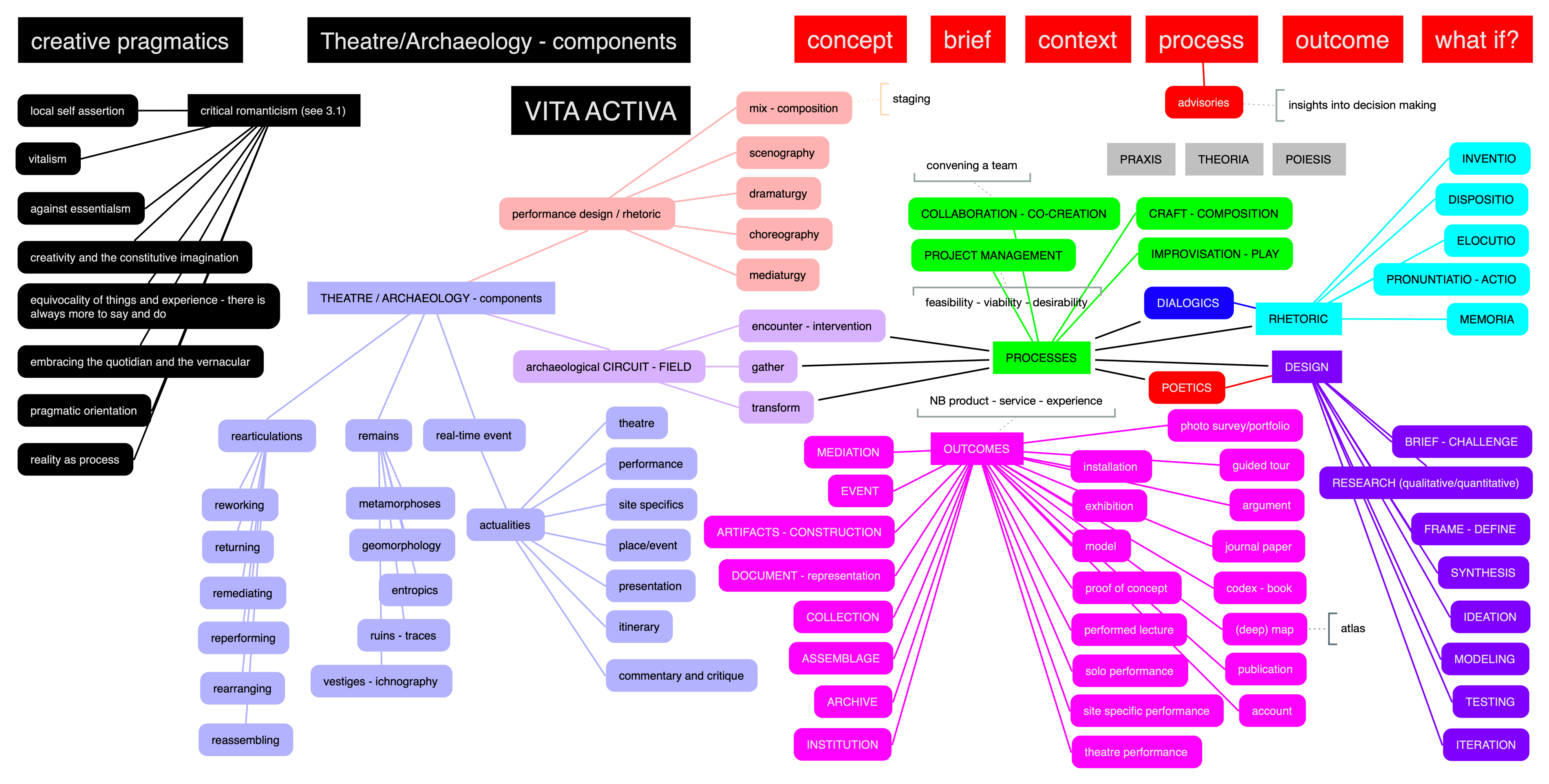
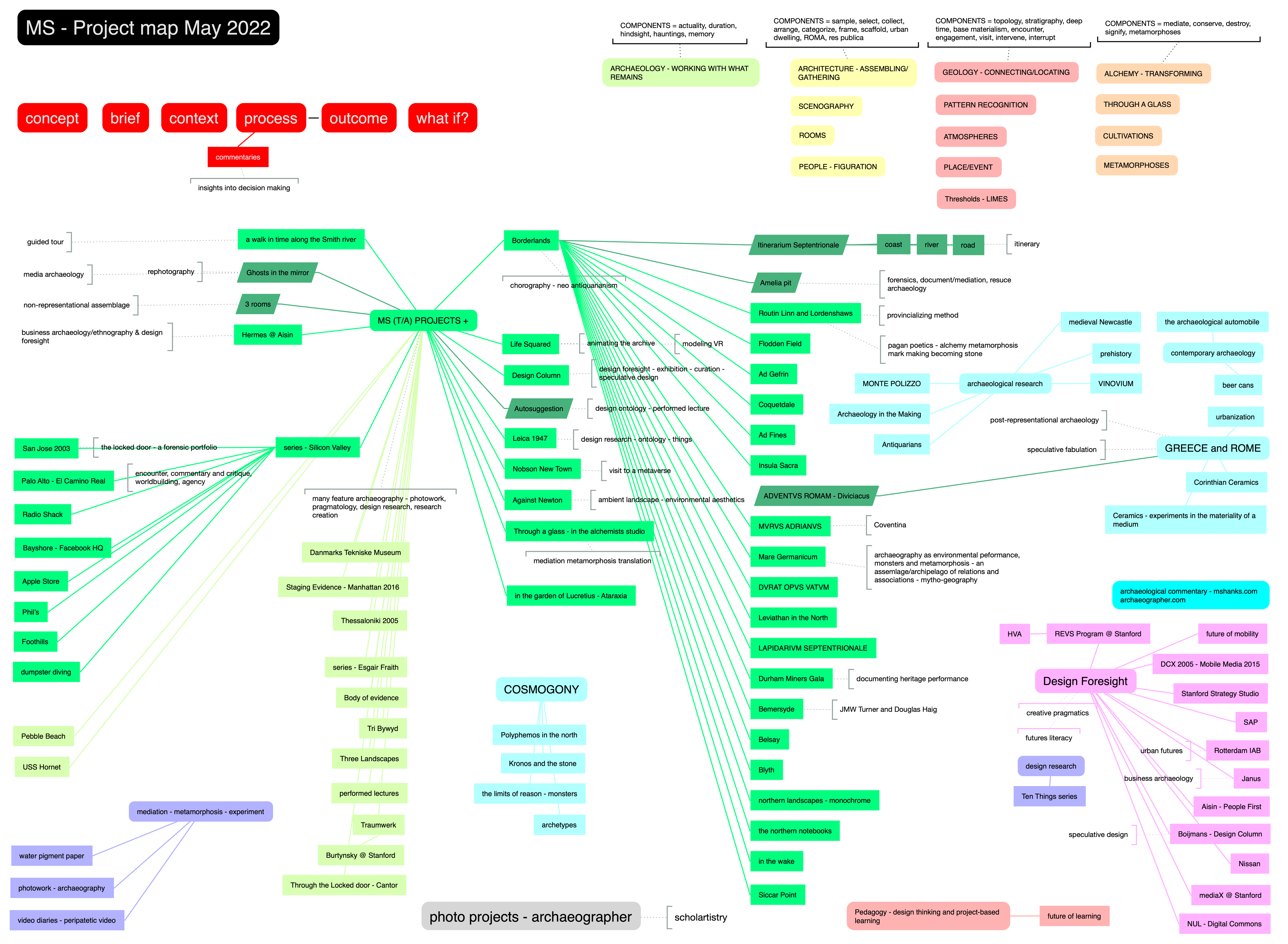
Below are some project mappings. Click on the image to load an enlargement.
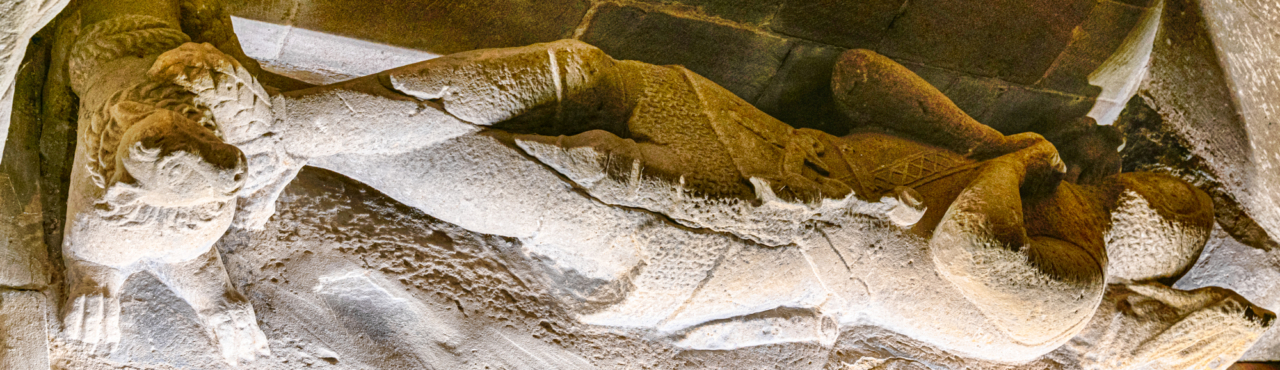
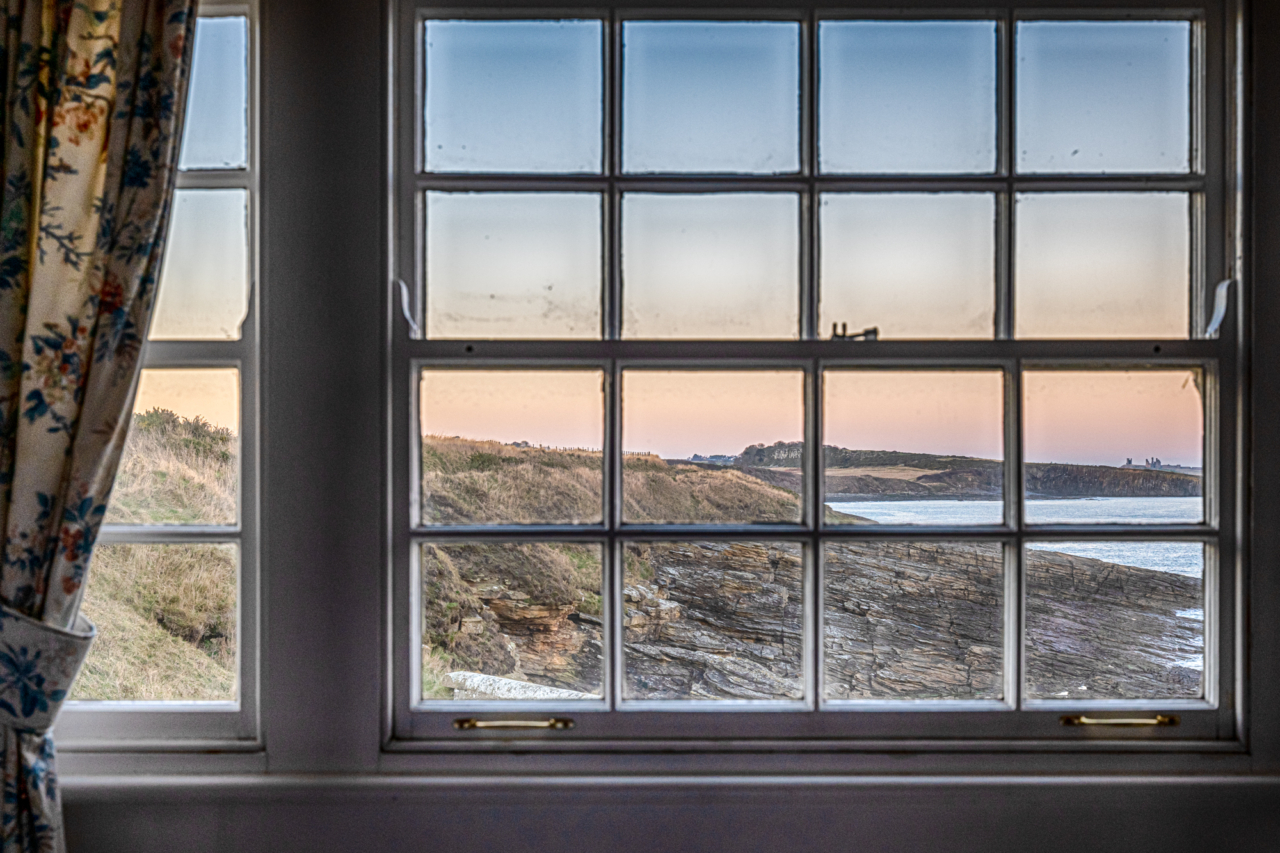
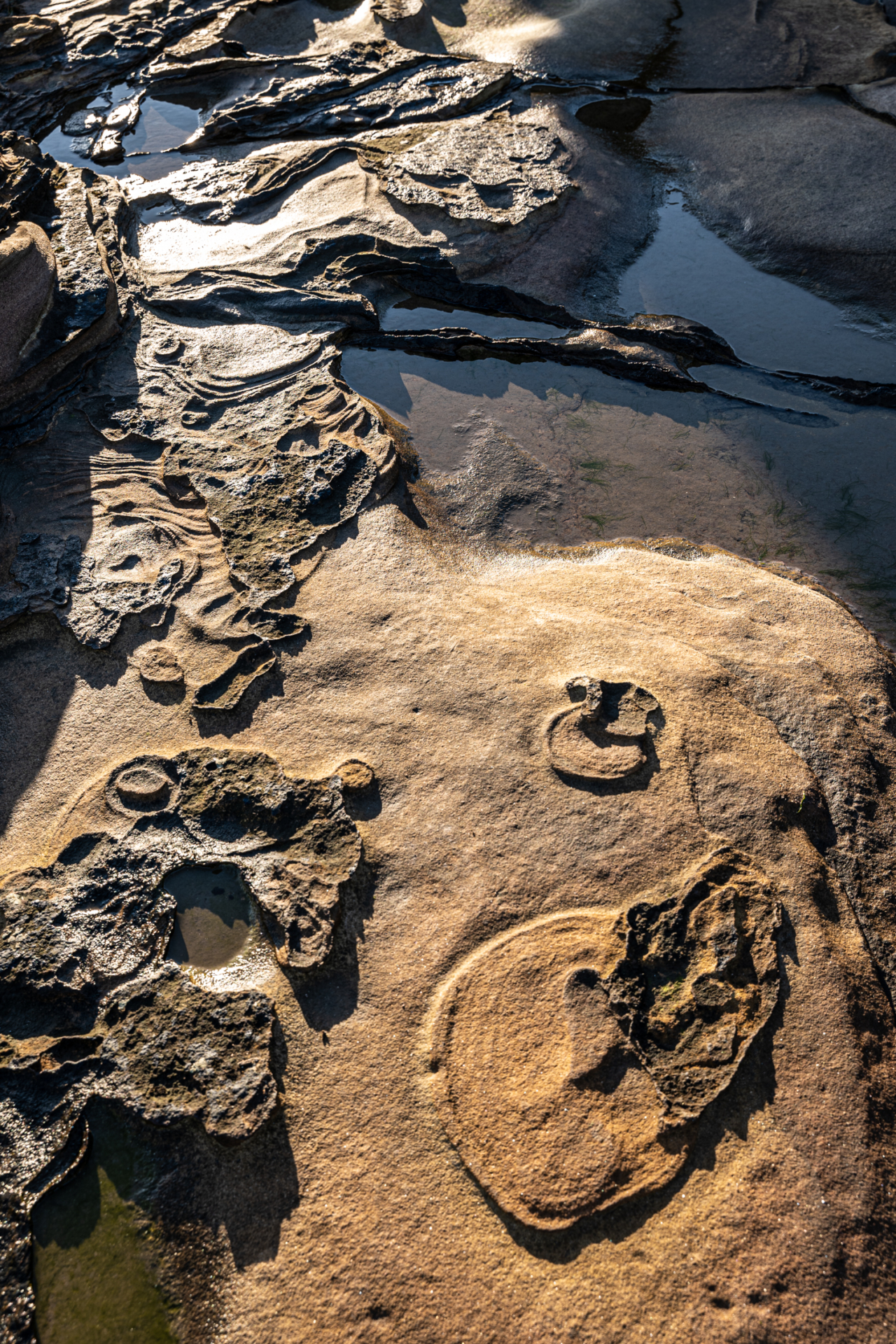
Theatre/Archaeology: concepts and practices – outline of the structure of the new book with Mike PearsonTwo long term reviews of projectsBecoming stone – St Aidan’s, Bamburgh, NorthumberlandFenestration – through a glass – Howick, NorthumberlandLiquid stone – fractal landscape – Rumbling Kern, Howick, Northumberland
William Blake – post-classicist
Recently I have been posting thoughts about the current state of Classical Studies, asking:
What might be done regarding the complicity of Classical Studies in ideological standpoints, including cultural chauvinism, nationalism, imperialism, colonialism?
I am much taken with dramatic techniques involving focus on characters and personae, avatars and ghosts, figuration and voices:
How might we create space for different voices?
The tactics I have found most useful in addressing these questions involve challenge and confrontation, facing down with discordant juxtaposition, precipitating friction through metaphor and allegory, actuality and synchronicity. Allegory – [Link] Synchronicity – [Link]
This has taken me to a discovery I made earlier this year about William Blake. I visited the big exhibition at Tate Britain [Link] in January and found it both spectacular and disappointing. It was comprehensive in presenting 300 works, but what struck me was a lack or absence, more accurately the presence of an absence – the extraordinary personal mythography and cosmography that Blake developed in and through his works, his world building. The exhibition did little to help us explore this component of his critical imagination.
Blake’s is a strange world. Figures that seem biblical or classical or drawn from an unfamiliar folklore feature in allegorical dramas. They are set in a strange liminal antiquity that is coextensive with the streets of Blake’s London and with newly emerging global geographies. Europe, the Americas, and Africa feature as personae, agencies in tension over their capacity to realize the emancipation of the human imagination. All this is realized in Blake’s experiments with text and image, textuality and figuration, mark making and printing, the page and the codex.
My fascination led me to buy an encyclopaedic guide to this fabrication, a gazetteer and dramatis personae – S. Foster Damon’s Blake Dictionary[Link].
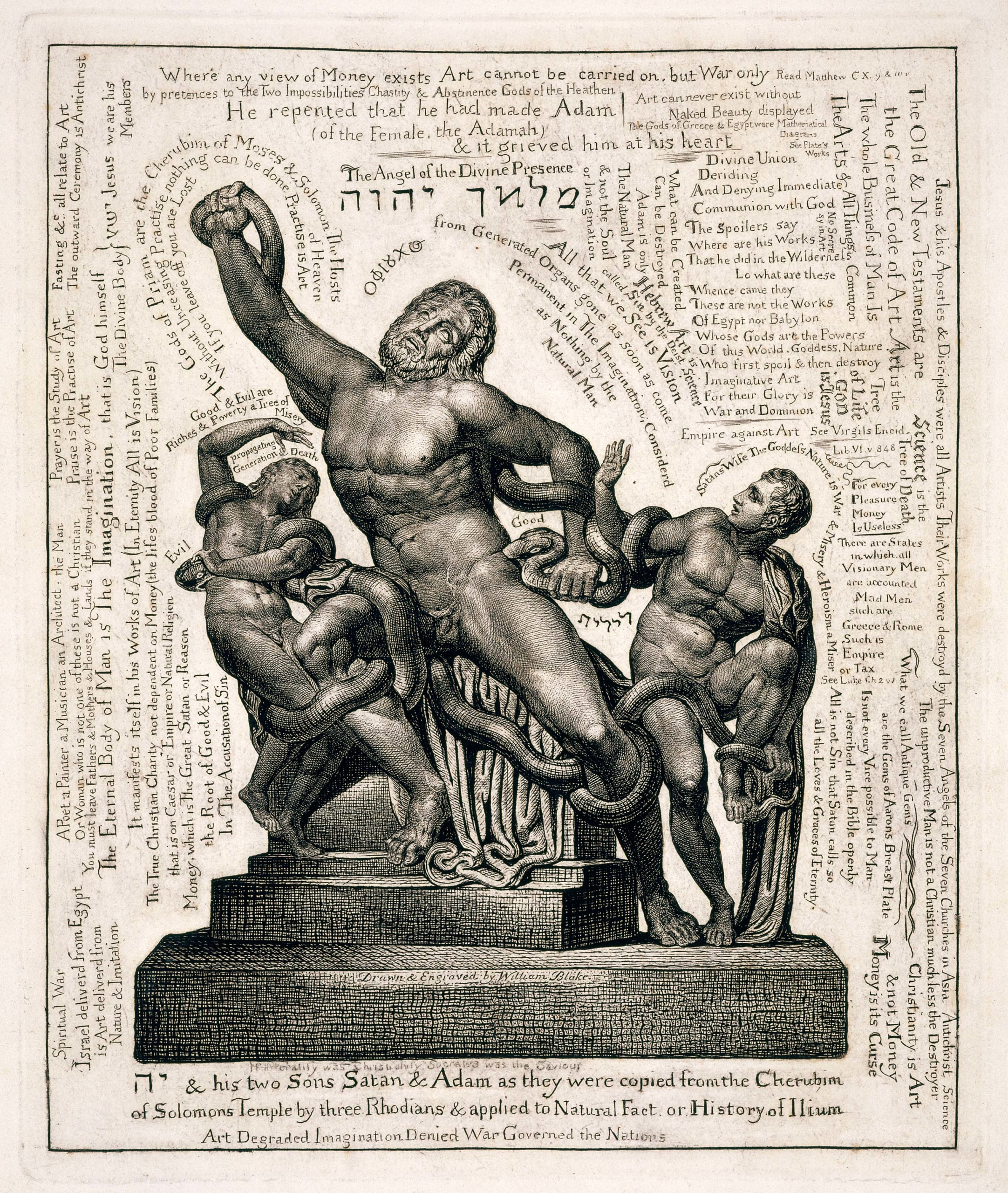
I came across an annotated drawing/engraving of the Laocoon a long while ago. I used it in my book Classical Archaeology of Greece[Link]. It’s only now that I’m realizing how it is such an expression of Blake’s extraordinary radicalism.
This is Blake as a post-Classicist, reframing (literally in his graphics), reworking the Classical through juxtapositions that still appear radically incongruent.
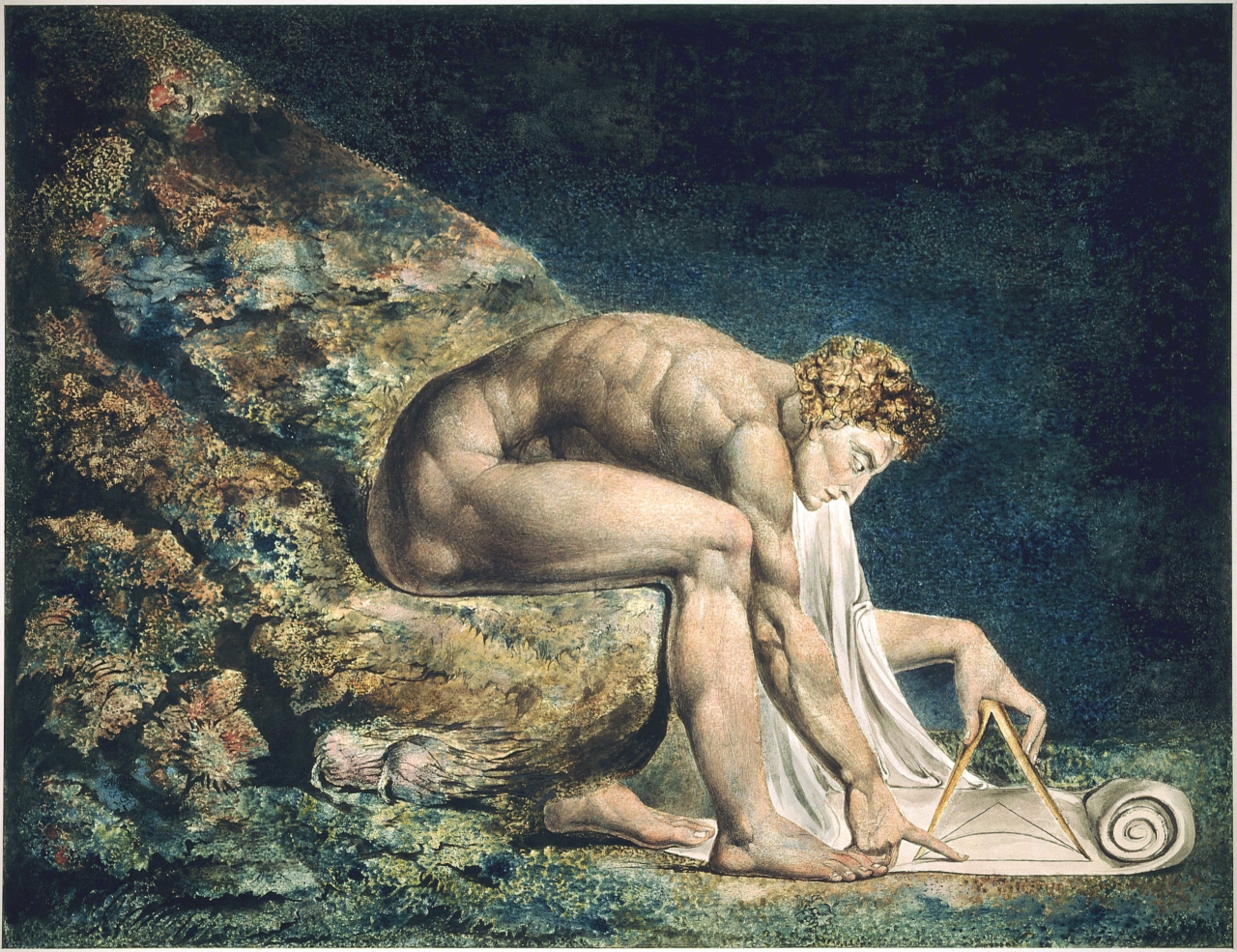
In the annotations we read fragments of flights of displacement, dislocation that take us far from the orthodox commentary on iconography and style. Such work of the critical imagination contrasts with Blake’s treatment of Newton – the failure of his Principia to reduce the world to rational, reasoned order and system.
See Irene Tayler on the annotated engraving – [Link] – in Blake: An Illustrated Quarterly.
I have contributed little to this site Since 2016. I have been writing (Greece and Rome: a new model of antiquity [Link]), running experiments in fieldwork (Project Borderlands [Link]), exploring applied archaeology (with a host of organizations and corporations), asking questions of the proper role of the academic, the researcher, the scholar.
In this contemporary condition of global stasis, COVID-19 virus and all, I am back to pick up where I left off.
Stasis? An artificial pause or hiatus, an interruption of normal flow, and, for Thucydides, writing of war, plague and democracy in fifth century Athens, a state of political crisis.
By 2013 we published an account and manifesto for archaeology and how to study things (Bjørnar Olsen, Christopher Witmore, Timothy Webmoor and myself – Archaeology: the Discipline of Things, University of California Press 2012). Archaeology in the Making (Routledge 2013), was the outcome of a long-running project in science studies; in a series of conversations held in the lab from 2002, we presented the human face of crafting knowledge and what actually goes on in a disciplinary field such as archaeology (it’s messy, pragmatic, personal and political). Archaeologies of Presence: Acting, Performing, Being (edited with Nick Kaye and Gabriella Giannachi, Routledge 2012) reported on a five year investigation of presence, absence, liveness and mediation in performance, the fine arts and beyond, and in the company of a remarkable group of artists. For me it was a project exploring the archaeological imagination; my book under that title came out in the same year (The Archaeological Imagination, Left Coast Press, 2012). It was also the fruit of my support for transdiciplinary projects, here art/archaeology.
Focused on the emergence of a new sector in the heritage industry, the Revs Program at Stanford [Link], from 2011 to 2015, connected the past and the future of the automobile. With changing experiences of mobility and the rise of the robot car, mobile media devices, and shared mobility services, questions are raised of what might be done with the remains and legacy of a century and more of car manufacture and car culture in the carbon economy that has run its course in modernity. We rehearsed issues in the curation of “active matter”, exploring just what is an automobile: its ontology is surely more than the coachwork and powertrain on four wheels. We also sought to understand the trajectory of automotive design such that it should inform the future of automotive systems – hindsight into experiences of mobility informing foresight.
The concept of heritage is most often understood as cultural property, something, tangible or intangible, that one owns and has a right to own through inheritance, by force of identity, who one is and is descended from. Our deep immersion in the contradictory worlds of car collectors, corporate design studios, automotive history, people’s memories, and the consequences of more than a century of gasoline consumption reveal the inadequacy of this concept in its partiality and promotion of disabling and conflict-ridden policies and politics. In asking what might be done with old cars and everything that goes with them we are dealing in relationships between pasts, presents, and futures. In this way the Revs program was about the actuality of the past, relationships, connections, engagements, as we work with what remains with a view to futures, planned, wished for, hoped for. Heritage, concerned with property and values, is but one kind of such relationship.
This key insight about the presence of the past and what we make of remains and legacies has come to be at the heart of another project, still ongoing. Gary Devore and I had decided we needed a text book for our Stanford class on Graeco-Roman antiquity, couldn’t find one to suit, and so set about writing one ourselves. Our aim is to explore the actuality of antiquity as we seek not to convey the wonders of ancient Greece and Rome (again), but to create fresh relationships with what actually remains, and given two millennia of both adoration and hatred of what Greeks and Romans have come to stand for.
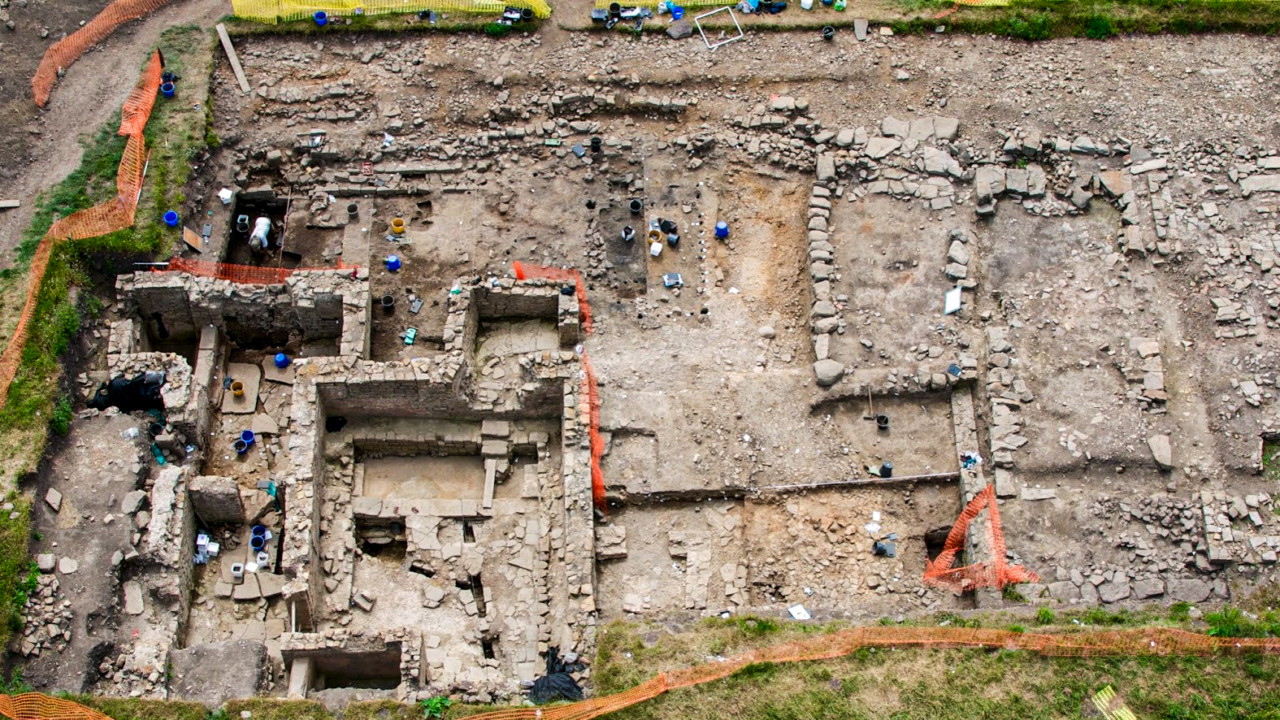
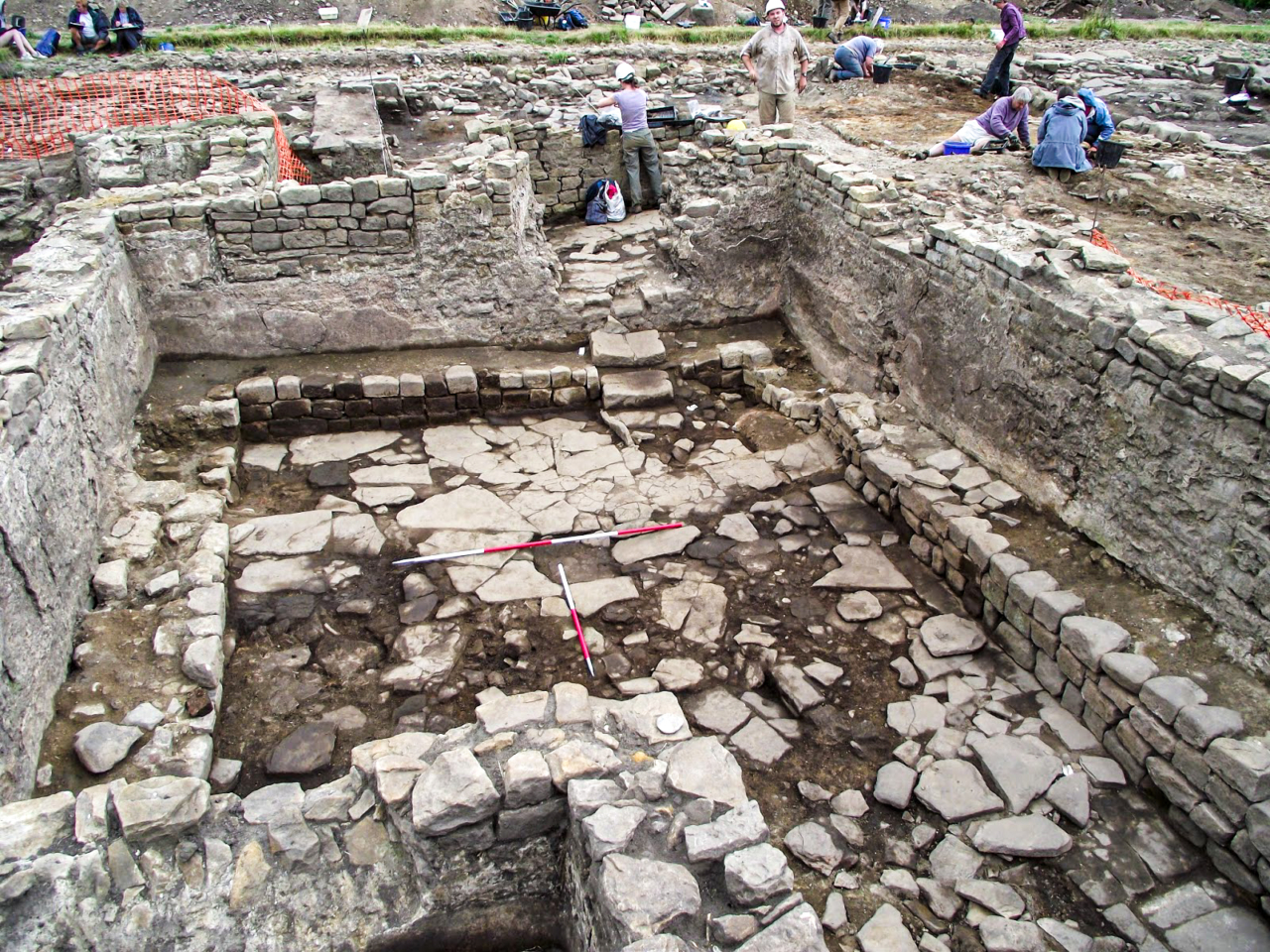
Meanwhile, Gary and I, and many lab members of our lab, have also been part of the excavations of the Roman outpost and town of Binchester, in the far north of empire. It began as a study of towns, cities and empires, through one remarkable instance (our book on Greece and Rome is, among other things, an account of experiences in the urban body politic). For me, this has grown into a study of borderlands, of bordering, edges, boundaries, transgressions, passages and resistances, in one of the most remarkable of archaeological landscapes.
Buildings along Dere Street, Roman province of Britannia, Binchester excavations, 2015.
Design and foresight
Actuality refers to dynamic connections between pasts and presents, seeking hindsight that we might achieve foresight in designing and building better futures. Back in the days of Stanford Humanities Lab (to 2009), Bill Cockayne introduced me to strategic foresight as a complement to the design thinking I was encountering in our school of engineering (through Larry Leifer, Center for Design Research, and David Kelley, Stanford d.school and the Revs Program). A project with Daimler Chrysler to design a concept car for the future based on archaeological/ethnographic research into experiences of mobility (Detroit Motor Show 2009) has led to a cascade of projects in strategic foresight and design thinking with many organizations, communities, corporations (and our group Foresight and Innovation remains very active – [Link]). Currently the lab is working in and through SAP on next generation design thinking and what we are calling business archaeology – shorthand for mobilizing (archaeological) hindsight that we might enhance our capacity to face uncertain futures with creative innovation [Link].
Some of the most inspiring connections have been in the Netherlands, and particularly Rotterdam. A decade of work with Rotterdam International Advisory Board (to 2017) was about helping this diverse community and municipality, city and port, navigate challenges and opportunities – urban futures. My role, as I took it, was to draw on the archaeology and history of urban dwelling to bring the human stories to the foreground of our concerns, and with a creative planning toolkit drawn from strategic foresight and design thinking.
Workshop on Foresight and Design Thinking, Groot Handelsgebouw Rotterdam, April 2017, with Janne Vereijken (Rotterdam Businesswoman of the Year 2018)
Projects with Museum Boijmans van Beuningen and the Dutch design community have introduced me to the ways that speculative design can be such a fount of cultural inspiration and hope. The museum itself, in its ongoing development, has become a model for the museum of the future, energizing what I am calling here the actuality of the past. [Link]
Asking questions of the proper role of the academic, the researcher, the scholar. The mindset I have described here, focused on the concept of actuality, is about ways that we explore, enhance, create dynamic connections, exchanges and flows – relationships and processes in toolkits and competencies, ways of managing projects, of attending to experience. This is quite opposed to barricading ourselves in the silos, the fortresses of disciplinary procedures and credentials, expert bodies of proprietorial knowledge.
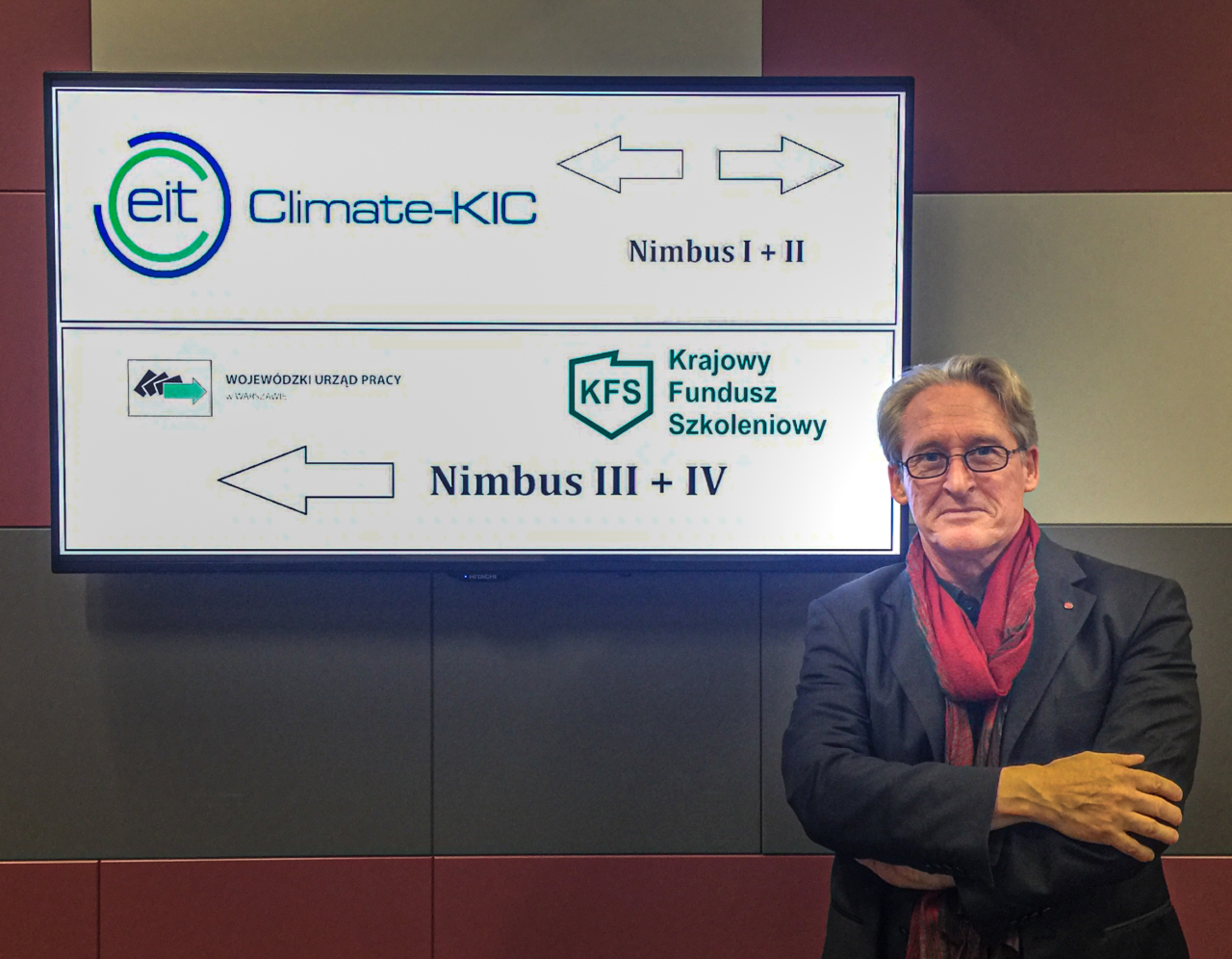
Running a workshop on innovation for Climate-KIC, Warsaw October 2016. “EIT (European Institute of Innovation) Climate-KIC is the EU’s largest public private partnership addressing climate change through innovation to build a zero carbon economy. We address climate change across four priority themes: urban areas, land use, production systems, climatemetrics and finance.” – [Link]
Pragmatics – pragmatology
There is such strong foundation for this pragmatic, this pragmatist stand. I have found myself over the last few years returning to favorite philosophers old and new who offer wonderful ways of fleshing out this mindset. I had forgotten until recently how actuality and potential for action was a topic shared by both Theodor Adorno and Walter Benjamin. Richard Rorty did such a great job of revitalizing Dewey’s pragmatism and Wittgenstein’s dissections of the fallacies in Cartesian dualisms, mind and body and all the rest. Bergson and Whitehead deal in the flows of experience, while Heidegger lays the foundations for understanding being-in-the-world that takes us way beyond the experiencing subject-self, reconnecting us with lifeworld. Process-based philosophy is epitomized for me in Gilles Deleuze. We are part of the world we seek to understand: this is a message of science and technology studies, notably Bruno Latour and Isabelle Stengers. To shift us beyond the narrow confines of anthropocentric humanism and the old notion that we take the role of observer in representing the world, towards more creative experiment we have Rosi Braidotti, Donna Haraway, Anna Tsing, Yuriko Saito, Michel Serres and Connie Svabo.
Three summary pointers.
Be sensitive to locale. Universal knowledge – knowledge that exists beyond temporal and spatial location – is untenable.
Seek verbs not nouns. Look to flows of experience, exchanges and transactions, energy dynamics, lifeworlds constantly in creation.
Take a pragmatist stand. Seek opportunities to intervene, comment, make a difference, in actuality, sensitive to opportunity (kairos), the current conjuncture.
Three questions of What?
What do we have to say now, in these circumstances? For whom?
So what? Who cares? Why would anyone be bothered?
What next? Where’s this taking us? To what end?
Historic Vehicle Association of America – pop-up museum in Manhattan. December 2016. Archaeology as orientation on future automotive design