Performing the archive — a study in theatre/archaeology
In July I posted a response to Nolan’s Odyssey [Link] — an old story, I argued, but not the one that was being talked about. The movie faithfully restages not Homer but a nineteenth-century grand narrative of civilization and its fall. A month of reviews and a billion dollars later, and I’m the only one to have questioned the source and validity of this metanarrative. This post restates my case plainly, and then investigates the media machinery that has installed and sustained this understanding of the shape of history — the genre of “big history”, rolled out by academics since the eighteenth century, and now a fundamental component of popular cultural ideologies. Again I flag the question that all the reviews and commentary keep burying: not why civilizations fall, but how any world holds together at all.
The question nobody has asked
The reception of Nolan’s Odyssey is now an archive in its own right: I have tracked four hundred and eighty-nine reviews, a wave of extended essays, a translator’s feud, a celebration of interest in Classics, a casting conflict, even a geopolitical incident. Points of debate: fidelity (is this Homer?); accuracy (Corinthian helmets, a masked Agamemnon); casting; the missing gods; the constrained women; the ethics of the shoot; Nolan as auteur interested in certain psychological configurations of masculinity. Some of these debates matter; I contributed to several in my July post — on the disenchanted cosmos, on the dual role of actor Nyong’o, on media spectacle fighting the movie’s message — and I stand by all of it. I will not rehearse those arguments here; they are on this site already [Link].
But run through that whole archive looking for one particular question and you will come up empty. The movie’s scaffold — a story of the fall of civilization — has been named by nearly everyone. A film journalist saw in week one that “the collapse of civilization comes from within, and from the corruption and erosion of literal civility.” Rolling Stone called the movie “a powerful warning about the dangers of civilizational collapse for our time.” A classical archaeologist praised Nolan for marrying literary tradition to “the historical reality of the Bronze Age collapse.” The Hudson Institute celebrated “a defense of Western civilization”; the essayists of the center-left read the third act as an indictment of contemporary imperial decline; Ezra Klein found a civics lesson [Link].
Named, endorsed, deplored, weaponized — across a month of debate and through every position on the political compass, this framing, this plot, this scaffold has never once been treated as what needs examination.
Civilization = stability, threatened by moral failure, ending in fall: nowhere is this equation questioned.
The description is unanimous, and I suggest that the unanimity is telling. When the same narrative frame can host the defense-of-the-West celebrant, the anti-imperial essayist, and the civics columnist simultaneously — three incompatible politics in one structure — ideological work is being done by the narrative scaffold, not by the tenants.
So let me restate what the frame is, where it comes from, and why it deserves the examination it has not received. And then let me go somewhere my July post did not: to the question of how a two-hundred-year-old historiography came to be so completely installed in a modern audience that a filmmaker could build a billion-dollar movie on it without a word of explanation — and no reviewer would think to ask about it.
The old story
The movie’s scaffold is a grand narrative, a metanarrative, and an old one: the fall of civilization. Nolan’s Odyssey moves through a world in which Zeus’s law of hospitality — that strangers be offered welcome — is being abandoned. This xenia is the basic law of “civilization” in the movie’s moral economy, the root of social and cultural stability; when one can no longer trust it to be universally respected, the way lies open to violence and chaos. The episodes are serial manifestations of this fall from social grace — the sack of Troy; Polyphemos the monstrous host; the Laestrygonians massacring visitors from the sea; the suitors devouring their host’s stores. The drama registers the fall in the story of Odysseus himself, a reverse Bildungsroman in which the hero is educated downward into the ruin of an old way of life.
Note the shape: a stable order, secured by a universal ethics, held in trust by a fellowship of men, threatened by mobile others, strangers not like them, lost when the men who should know better abandon the values that bind. That shape has a birth certificate. The concept of civilization in this sense — civility, civil society, set against barbarism and savagery — took its decisive form in roughly 1750–1830; the second half of the nineteenth century institutionalized it, diffused it globally, and put it to work in the service of colonial governance. Its narrative arc — stable civilization undone by the ethical failure of its own men and loss of civic virtue — is the trope Edward Gibbon made canonical in The History of the Decline and Fall of the Roman Empire published 1776–1788. Neither anachronistic nor woke, Nolan’s movie is a key trope of colonial-imperialist ideology transcribed into Hollywood spectacle.
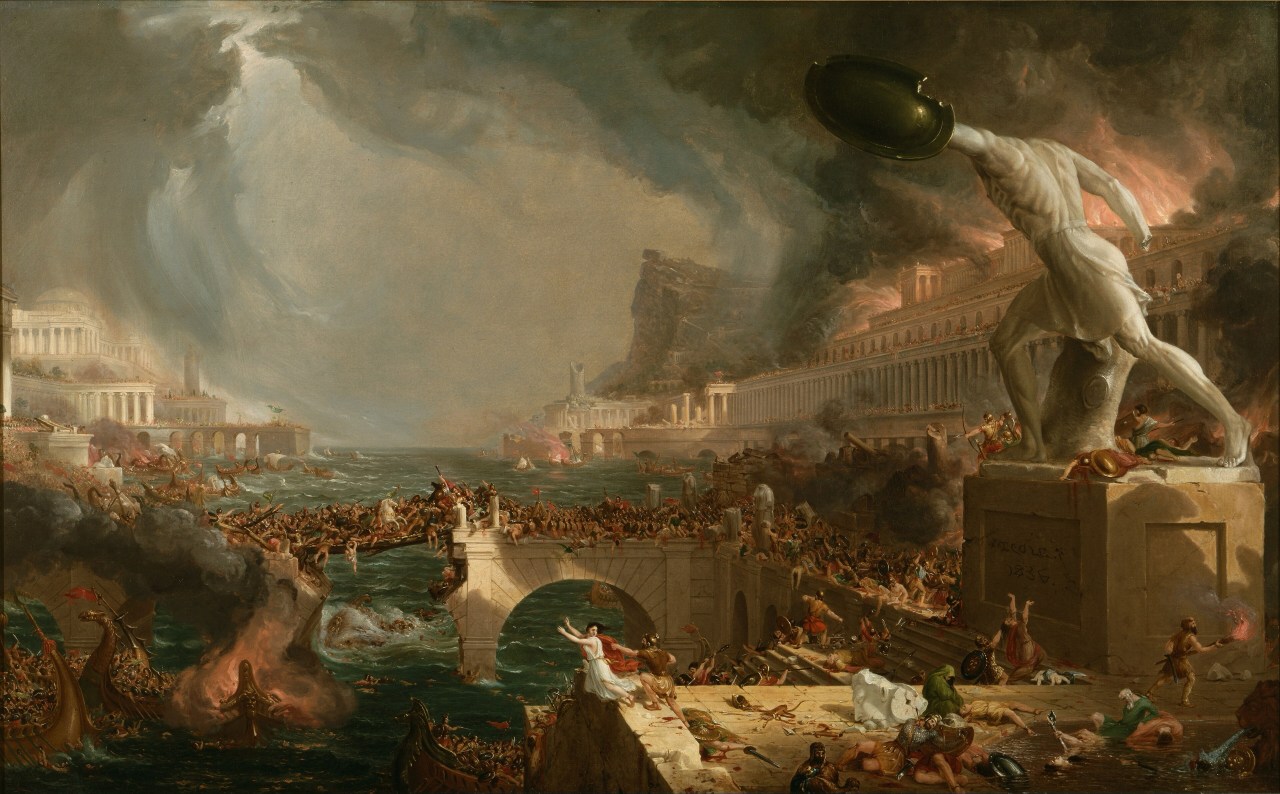
Thomas Cole, The Course of Empire: Destruction (1836, New-York Historical Society). The Universal Collapse Narrative as a painting — the wheel of civilization rendered in five canvases, American anxiety dressed in classical drag, ruin as sublime entertainment decades before Maspero coined the term “Sea Peoples.”
The movie maps this narrative scaffold onto an archaeological setting: the “collapse” of the eastern Mediterranean world at the end of the Bronze Age. Nolan has Odysseus declare, after Troy, that the age of bronze is ending — a character inside the thirteenth century BCE announcing his own archaeological periodization, naming his civilization as a bounded, datable, terminable thing. And the sea peoples, invoked throughout, arrive as the harbinger of the end of times: anonymous, armed, seaborne. The popular source is not in doubt. One reviewer would “bet money Nolan read Cline’s book” — Eric Cline’s 1177 B.C.: The Year Civilization Collapsed. A journalist’s speculation, but a telling one, because it shows how completely the collapse story now circulates as received truth: an archive to be performed rather than a question to be asked.
Yes, the movie complicates its own allegory. The third act reveals that the “people from the sea” are the Greeks themselves — the victorious coalition, brutalized by its own war, together with those displaced by Troy’s fall. We are the sea people, the movie all but states, and some have celebrated this twist as the film’s redemptive political move. I take the point; it is a better movie for it. But the twist confirms rather than escapes the old story. Moral failure of the men who should have known better; civilization undone by the abandonment of its own values — the villain is swapped (outsider strangers to insiders), but the historiography stays. America-as-fraying-empire is not a subversion of Gibbon’s narrative of decline. And a late revelatory twist does not un-show two hours of images of civilization threatened by armed arrival by sea, in a mediascape where such imagery has a settled political charge. The conservative right, receiving the movie gratefully as “anti-mass-migration propaganda,” understood the iconography perfectly well. Iconography works below the level of plot.
There is another piece of evidence that the scaffold is modern, and it comes from the movie’s most prominent admirer. Ezra Klein, celebrating the film in the New York Times, concedes (“as a horde of classicists have pointed out”), that the movie’s Zeus’s-law is not Homeric xenia at all, but a Judaeo-Christian ethic [Link]. Homeric xenia is narrower, prudential, enchanted: the stranger might be a god. What the movie preaches instead, Klein documents chapter and verse — Leviticus, Hillel, Matthew — is “the core of Judeo-Christian ethics,” which Nolan has “smuggled” into the poem; Klein calls the smuggling Nolan’s “finest trick,” and applauds. Note what has happened: Klein the celebrant documents the import, names it smuggling, and celebrates. And the case goes deeper than he allows, for “Judaeo-Christian” is itself substantially a twentieth-century coinage, forged to give “western civilization” a shared moral pedigree. So the movie’s universal ethic is a twentieth-century composite of Gibbon’s civic virtue and Judaeo-Christian commentary, retro-projected as the timeless Golden Rule, retro-projected as Zeus’s law, retro-projected onto the Bronze Age, a construction of nineteenth-century archaeology founded upon eighteenth-century philosophical anthropology. Rehash stacked on rehash. Even those who love the movie agree: the ethics is not Greek, and the civilization it secures is not ancient.
What the archaeological archive tells you
There was no collapse of civilization at the end of the Bronze Age.
Now set the trope against the evidence to which it looks for support. The archaeological evidence of the end of the Bronze Age does not deliver a story of the fall of civilization. That story has been coming apart for a decade, in detail.
The old case has a wave of destruction occurring c1200 BCE across the eastern Mediterranean — a map of catastrophic collapse. Jesse Millek went back to the excavation reports and found that of 153 destructions, some sixty percent are false — misdated, assumed without excavated evidence, or resting on citation chains the original reports do not support. The genuine destructions are smeared across fifty to a hundred years and more, most of them partial, many touching a single building; single episodes in long sequences of destruction and rebuilding. The famous distress letters from Ugarit name no destroyer at all; read closely, the richest of them point inward, to a Hittite tribute demand escalating into overdemand — famine worsened by the empire’s own extraction. And the consistent picture across the millennia since the emergence of city states in Mesopotamia is not of stable states, alliances, empires, but of constant conflict, competition, interaction marked by dynamic shifts in dominance and subordination.
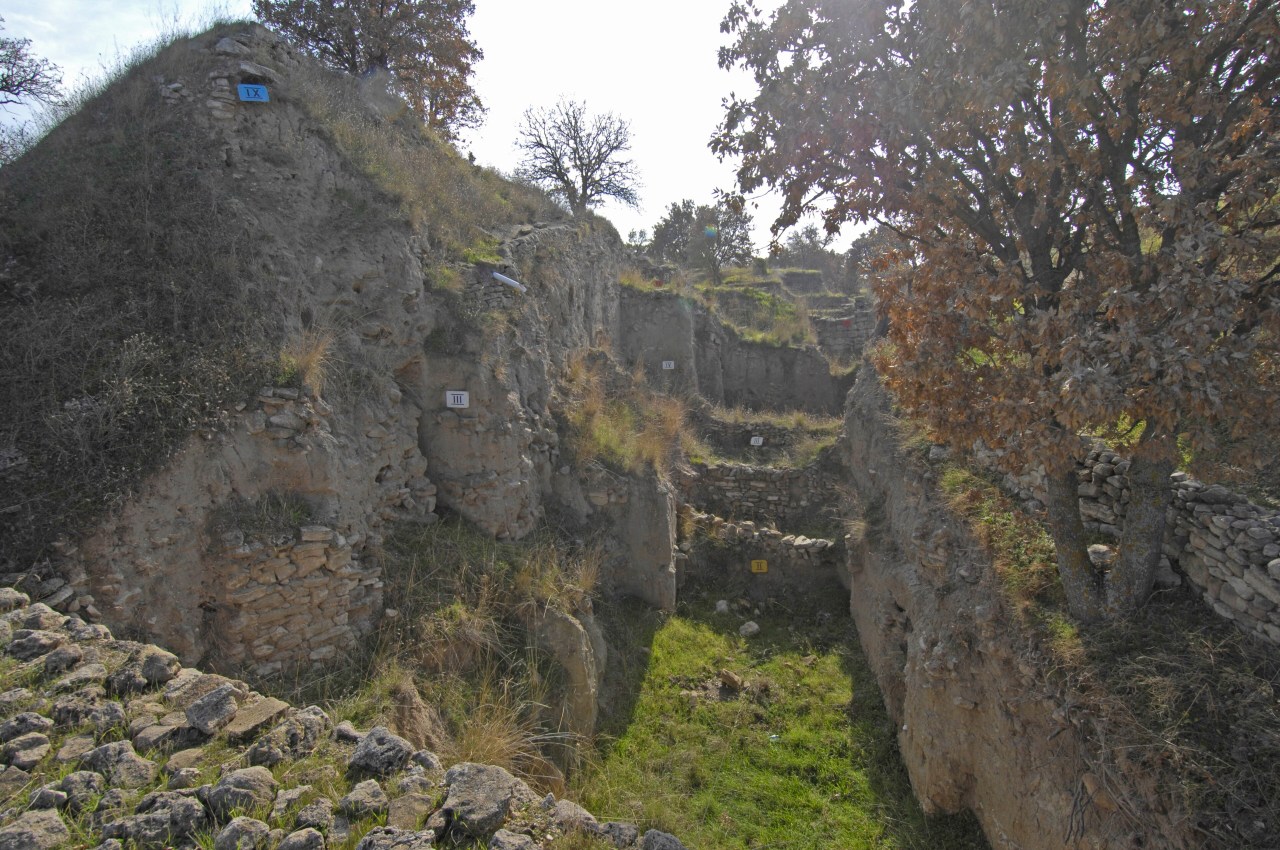
Schliemann’s Trench at Hisarlik, the 17-meter cut he drove through the mound between 1871 and 1890, which today displays the superimposed cities in open section. Stratigraphy and argument in one: the man hunting a single Homeric horizon cut straight through eight other Troys to reach it — destruction-and-rebuilding stacked in one face of earth, with the “one collapse”, the fall of Troy. nowhere to be seen.
What’s more, the very term “Sea Peoples” is a modern coinage — Maspero came up with the term in 1881 — consolidating heterogeneous Egyptian references into a single invading force. Ramesses III’s inscriptions at Medinet Habu, documenting his military victories, are pharaonic propaganda obeying pharaonic convention. The unified seaborne destroyer, collectively termed “the sea peoples” three thousand years later, is a construction of their enemies’ imaginations. And the movements the label bundles together included ox-carts, women, and children — migration, not armada. The movie has made literal a propaganda construct: ancient Egyptian state media, laundered through nineteenth-century migrationist fantasy, projected onto the screen as archaeology. And even here the movie’s paradigm of armed invaders is behind the times: the thesis that warfare was behind the systems collapse was discarded decades ago. The supposed science on screen is, at best, the fake archaeological science of c1993.
Beneath the horizon of 1200 BCE run deep continuities of settlement, practice, and lifeway that point to transformation in elite lifestyles and power networks rather than “systems collapse.” And more fundamentally: social stability is not the norm in prehistory and antiquity, to be assumed until it fails. Mobility, volatility, diversity, change are ever-present. What requires explanation is metastability — how elite networks held together as long as they did, in the face of tension and contradiction; what it cost to keep the tin moving and the tribute flowing and the palaces standing; how often these systems wobbled and were repaired before the wobble we retrospectively crown “the collapse.”
Here’s a quick elaboration of this crucial concept. Metastability: the appearance of permanence in a system held far from rest — an order that persists not because it is stable but because it is continuously maintained, at cost, against ever-present volatility, and that can therefore shift abruptly when the maintenance fails. Applied to antiquity: the palace, the trade network, the tribute system were not the ground state of a stable civilization occasionally toppled; they were ongoing accomplishments — daily work of supply, negotiation, and repair — whose seeming solidity was the work made invisible. Stability is not the default that collapse interrupts; it is the achievement that needs explaining.
The question is not why civilizations fall but how they ever manage to stand — and why they get called “civilized” in the first place by the archaeologists, anthropologists, and historians of the nineteenth century and after. Ask that question and the entire moral apparatus of the collapse narrative — the warning, the declension, the fall from grace — simply dissolves. Which is, I suspect, why nobody asks about it. Not the contemporary apologist for this fabrication — Eric Cline.
Except that someone did ask it. And that someone — Edward Gibbon himself — is devastating to this current debate. Gibbon was no careless mythmaker; he was the scrupulous one. Momigliano, a paragon in the scholarship of antiquity, located Gibbon’s greatness precisely in fusing the two traditions his eighteenth century held apart — the antiquarians’ erudition, the footnote, the primary source, against the philosophers’ narrative sweep — and his accuracy commands respect to this day. The narrative arc he upheld was not a failure of his scholarship; it was a choice made prior to it, the form the scholarship was poured into. And Gibbon knew. Here he is at the very summit of the narrative of decline:
“The story of its ruin is simple and obvious; and, instead of inquiring why the Roman empire was destroyed, we should rather be surprised that it had subsisted so long.”
General Observations on the Fall of the Roman Empire in the West,’ appended to ch. 38 of The Decline and Fall of the Roman Empire (vol. III, 1781)
The founder of the fall-of-civilization tradition concedes that the real question is the one I am asking in this post — how did “civilization” hold together at all? He states the question and then writes a story of the fall anyway, because the fall was what his form, his readers, and his irony required. The metastability question I am raising here now is not a twenty-first-century revision of Gibbon. It is Gibbon’s own buried comment, smothered for two and a half centuries by the narrative arc he closed over it.
Where the reflex to accept the narrative of collapse came from
Here is the puzzle worth dwelling on. Specialist archaeological research has spent decades moving away from the collapse story — toward transformation, continuity, regional divergence, the dissolution of the very unit “a civilization.” Yet a filmmaker in 2026 could assume, correctly, that a mass audience would hear “the age of bronze is ending” and supply the whole apparatus themselves: the stable golden world, the barbarians at the sea-gate, the fall. Where did that reflex come from? Not from the excavation reports. It came from a genre.
Call it big history, the universal synthesis, the whole-human-story book. Gibbon is its ancestor, Spengler and Toynbee its systematizers; its current bookshelf runs from Diamond’s Collapse and Harari’s Sapiens through Graeber and Wengrow (Dawn of Everything) to Kemp’s Goliath’s Curse, with Cline’s 1177 B.C. as the Bronze Age franchise. Its contract with the reader is constant beneath the changing covers: the author will give you the whole human story and its moral in one volume. Its dominant product is what might be called the Universal Collapse Narrative — the past organized as a cycle of rising and falling civilizations/societies/states/empires, with the present read as the latest, highest-stakes turn of the wheel. And Greece and Rome, I note with professional discomfort, are the genre’s load-bearing examples — the cases that made the templates of rise, decline, and fall feel like descriptions rather than inventions.
The complicity runs much deeper than the shelf of trade books, for the arc is built into classical scholarship’s own chronology. Hellenistic critics back in the 200s BCE invented this scheme for art — rise to an acme after which, in the tradition Pliny transmits, cessavit deinde ars (“then art ceased”). Vasari revived the scheme in the sixteenth century as an ascent to perfection. And Winckelmann, in 1764 — squarely inside the window in which “civilization” itself was being forged — welded it to Greek art and to liberty: style rising with freedom, declining with its loss. The nineteenth century hardened his sequence into the period labels every student still learns, and the labels perform the parabola all by themselves — “archaic” means before-the-classic, “Hellenistic” has long meant decadence. Every survey course that walks from archaic through classical to Hellenistic teaches rise, maturity, and decline before anyone has mentioned a sea people. This was exactly my target in ten years of research into the design and making of ceramic “art” in the early Greek city state — to challenge on every ground this template of rise, maturity, decline and fall (Art and the Early Greek State, 1999).
The discomfort is also local: big history has a Stanford address. Ian Morris wrote the energy-capture version down the corridor from me here at Stanford, scoring civilizations across fifteen millennia like decathletes; Walter Scheidel, the school’s most disciplined member, counts levelling violence through five thousand years. Across campus at the Hoover Institution, in their “applied history”, Victor Davis Hanson retails ancient annihilations as warnings for the present emergency, while Niall Ferguson has issued to the West its six “killer apps.” The gradient runs, within one university, from survival curves to civilizational league tables to the defense of the West. When the movie’s celebrants called it a defense of Western civilization, they were not misreading it; they were shelving it correctly.
Now here is the point I most want to make, because it revises my own critique. The narrative trope has not been consolidated primarily through academic research. The research, as we have seen, points the other way. The consolidation has happened in the trade press, in two decades of collapse bestsellers, TED talks, TV documentaries, and YouTube videos that have installed the wheel of civilizations as ambient cultural apparatus, something an audience carries into the theater without needing to know where it came from. That is why the movie needs no exposition: the books did the teaching maybe, but what they taught has now detached from them. The Universal Collapse Narrative has escaped its genre. It no longer needs the six-hundred-page synthesis with its dataset and its hedged footnotes; it persists as a free-standing scaffold available to any work — a film, a column, a security-policy essay — that wants the authority of deep time without the argument. The movie is not big history. It is what big history leaves behind in culture once the books are read and forgotten: the shape without the argument, the moral without the data, the wheel without the machinery that drives it. The genre’s true product, it turns out, was never the thesis. It was the reflex.
In science studies this gets called black-boxing. Complex processes and apparatuses packaged and contained within a closed box that one doesn’t need to open and inspect, because one can simply observe the regular inputs and outputs. Performance over inspection.
And with the data gone, what the reflex delivers stands exposed as something older than historiography. Watch what the movie actually provides, in IMAX: an ordered world under law; a charter — honor the law or the world dissolves; and an ending, forecast and consummated, with the wheel’s next turn gestured in the coda. Cosmogony, nomos, eschatology. Genesis, Law, and Apocalypse. Two hundred and fifty million dollars, delivered — the future colonized. Big history was always mythography — the grand récit that postmodernism pronounced dead, re-authorized by data rather than by Spirit or Progress; myth that disavows itself as science. The movie completes the disavowal’s collapse: the myth performs naked with no evidence, argument, no costume. And nobody in the audience needs the footnotes, because the footnotes were never the point.
But is the story not simply there?
I am highlighting and finding fault with the significance of overarching scaffolds and frames — metanarratives. This target of metanarrative is sometimes taken as a foundation of postmodern critique. Let me anticipate an objection to such a critique of metanarrative, and at full strength, because it is the big historians’ best defense.
Incredulity toward metanarratives, a critic might say, is itself a metanarrative: a story about the end of grand stories, told with all the sweep it forbids, self-consuming from the first page. Implied is a counter metanarrative, at best, of complexity, indeterminacy, relativism (we are trapped in the prejudices of our own contemporary times) — a postmodernist nihilism that finds fault in every foundation, including that of the intrinsic worth of “civilization”. Beneath such a criticism sits a serious empirical claim. Some processes in history really do have regular and recognizable shapes. States form, extract, over-extend, and fail; demographic and fiscal rhythms recur, and the cliodynamicists model them with genuine predictive risk; the Aegean palaces really did burn, and Linear B really did vanish before the alphabet arrived in the Aegean four centuries later.
On such a view the grand narrators are not imposing arcs but detecting them, as geology detects cycles of orogeny and erosion — and the humanist’s insistence on irreducible particularity is the anecdotalist’s refusal of statistics. Compression, summary, pattern finding, the critic might continue, is not a vice but a necessity of scale: any account of ten millennia must compress; a thesis is honest compression; a plural past held open is compression by evasion.
Grant what must be granted. Recurrence is real; compression is unavoidable; the best quantitative work does expose itself to disconfirmation. No one mobilizing forty story-scenarios of antiquity, as I am with Gary Devore in our long-in-composition account of antiquity Greece and Rome: Speculative Scenarios, gets to claim the high ground of no-stories. The critique was never that there are no regularities, patterns, dynamic processes, no shapes to history. This critique of metanarratives is about what the shapes of history are, where they come from, and how they are held, who they serve, and who gets left out in the summary compression.
If the metanarrative of collapse was a discovery or detection of real pattern, its instances would converge — the same evidences yielding the same narrative arc, as the rocks do for the geologists. Instead the genre’s own history is a sequence of incompatible shapes and patterns confidently extracted from essentially the same evidence: Gibbon’s declension, Spengler’s organism, Toynbee’s challenge-and-response, Diamond’s environmental verdict, Harari’s ascent of fiction, Scheidel’s escape, Kemp’s curse. One might claim that there is new evidence; this is a regular claim in archaeological news — “this new evidence changes the way we understand history”. What I am saying is that, whatever the evidence, old and new, narrative account is always underdetermined — never fully substantiated. Gaps and inconsistencies always have to be filled. Underdetermination on the scale of big history is not about detecting faint traces. This is projection, serially. Each narrative arc, each pattern or shape of history is read off the same data with equal assurance, just as each author assures the reader of such unique command of the evidence that affords them fresh insight (“it’s not civic virtue, or demographics, or geography, but creative serendipity”, says the recent offering from Patrick Wyman).
The (meta)narrative arc curates the data rather than the reverse. That is what Millek’s audit of the archaeological evidence for the Bronze Age collapse points to — curation. Sixty percent of the destructions on the collapse maps are false, accumulated through citation chains drifting, decade after decade, toward the story everyone already knew. The narrative did not summarize the excavation reports; it edited them. A critic might claim the metanarrative is empirically valid; the Bronze Age case shows the empirical record itself was shaped by the metanarrative. That is not a postmodern assertion. It is a finding, with percentages.

The 1874 photograph of Sophia Schliemann wearing the “Jewels of Helen” from “Priam’s Treasure”. A person literally performing the archive — the present dressing itself in a fabricated past and calling it recovery. It condenses “an archive to be performed rather than a question to be asked” into a single face.
Hayden White, the philosopher of history, a sadly-missed friend and colleague, saw all this coming. His book Metahistory argued — half a century ago now — that before a historian explains anything, the historical field is prefigured and emplotted: Romance, Tragedy, Comedy, Satire. Poetic acts, prior to the evidence, determining the shape of the account and carrying an ideological payload the historian need not intend. White read the late Enlightenment, Gibbon included, under Irony — the solemn scoffer-sceptic whose scrupulousness was the vehicle of an emplotment chosen in advance (I recall finding exactly this scholarly character in the debates involving Walter Scott, James Macpherson, Joseph Ritson at the end of the eighteenth century and covered in my book The Archaeological Imagination). His point was never that historians lie or that evidence does not matter; it was that the shape is made, not found, and that the making does political work. The maps of prehistoric destructions drifting toward the expected catastrophe are prefiguration caught in the act, in the citation record; big history is emplotment industrialized; and the movie is emplotment with a production budget — tragedy at two hundred and fifty million dollars, earning many times more in real cash, not just cultural capital.
So my stand with Hayden is not incredulity toward metanarratives; it is attention to their poetics. Every account emplots — my own included. The difference that can be defended is not innocence but avowal: say what shape, pattern, narrative arc you have chosen, hold it in the plural, and submit it to the same tests you apply to others. My own metastability inversion does not get a pass on such an evaluation — I have said elsewhere what would count against it, and the Aegean, where something did rupture deeply and irreversibly, is exactly where the accounting is due.
Six questions to carry out of this theatre/archaeology
These questions, I should say plainly, are Hayden White’s insights turned into a playbook — Metahistory turned into an instrument you can use in the bookstore.
This is why the main line of critique of Nolan’s Odyssey should run through the concept of civilization and the shape of history — not through fidelity, accuracy, or even (though the matter is real) the politics of its casting. Replay rather than reenactment, as I argued in the first review I posted of Nolan’s Odyssey. The instrument I use on the genre works just as well on the movie, and I offer it to any reader; it is six questions.
1) Strip out the deep history: does the present-day warning weaken? (It does not — the Bronze Age was costume, supplying authority rather than evidence.)
2) Name the thing that is said to rise and fall: would any specialist accept “Bronze Age civilization” as a bounded organism with a lifespan — and who, in 1200 BCE, could have possessed that unit?
3) Name the master key — here, the abandonment of hospitality — and list what it must flatten to stay master: imperial over-extraction, regional divergence, millennia of smeared and partial destructions.
4) Ask what observation would count against the thesis — and notice that in a month of reception, every reading of the movie, including the twist that seemed to refute the migration allegory, was absorbed as confirmation of collapse; that is not insight but a mood.
5) Find the story’s implicit shape or form — tragedy — and ask where the shape, not the evidence, is doing the selecting. (The movie’s one open moment, “You are the people from the sea,” is spent as a plot twist and reabsorbed into moral allegory within minutes, because tragedy has no slot for an open question.)
6) Separate the historiography from the contemporary moral/message: the movie carried three incompatible political payloads in three weeks, which tells you the vehicle is indifferent to its cargo. A moral that needs millennia to sound true probably is not. The movie’s familiar nineteenth-century narrative frame carries the message — not Homer, or archaeology, or ancient history.
The movie fails all six. So does the shelf that taught it how — including the wing of the shelf at my own address.
How does any world hold together at all?
I can hear the reply: this refusal of the grand narrative offers only weak talk of “continuity” and “complexity” — the academic cop-out, nothing to inform a decision. Here are two answers, briefly, because they point to where my projects go next.
First, the objection mistakes a property of a medium for a property of knowledge. The definitive statement is a formal requirement of the 600 page book and the three-hour movie; and we have seen what its decisiveness delivers — fate. The wheel turns; the seeds sprout; prepare to mourn. That is not a means to support assessment and decision-making. I seek a pragmatist stand (and have outlined such at length in the collaboration Creative Pragmatics [Link]). Definitive statements — “this is the way history is” — foreclose any decisions that might counter the essential summary, with quietism in the face of expert authority dressed as realism. It is the genre of big history, not its critics, that commits the cop-out, for a definitive account of forces beyond anyone’s agency tells the reader precisely nothing about what to do.
The alternative is not vagueness but different mediations of past-in-present, built around agency — how things get done: who kept the grain moving, how a treaty was patched, what it cost to repair a harbor, a network, a peace. Efficacy, improvisation, maintenance, mētis. A public equipped with the working knowledge of repair is better placed, not worse, before the seemingly intractable, fate-driven forces of today — because it has been shown that the forces were never fate. They were held together, by people, at cost; and what is held together can be held differently.
The shape of history really is multiple — multivocal, polyphonic, polytropic — but multiple is not chaotic, and refusing the single narrative arc or analytic thesis is not refusing knowledge. The aim is a different kind of knowing: a heightened sensitivity to atmosphere, ambience, milieu — the shifting weather of the worlds people inhabit — awareness good enough to navigate by, to find one’s way. This is what a toolkit of dynamic concepts is for: agency as the capacity to get things done; heterarchy alongside hierarchy; lifeworld, assemblage, mobility, temporality — verbs rather than nouns, instruments that sharpen attention rather than representations to be judged true. Again I have attempted to show what all this looks like, and what it delivers — from accounts of the early years of the Greek city state, through temporal landscapes, to contemporary automotive design.
Odysseus, of all figures, is the emblem of exactly all this, as I outlined in my criticism of Klein’s review under the concept of mētis — trickster intelligence [Link]. Nobody has ever had a definitive account of the sea; the sailor has weather-sense, and gets home. Polytropos Odysseus — the man of many turns — is not a failure to be one thing; it is the oldest name we have for adequate knowledge of an unstable world. The movie straightened the many-wayed man into a man of a single way, as the genre straightens the many-wayed past into a single arc. The remedy is the same in both cases. Keep the turns — and keep asking the question this movie, its admirers, and its detractors have all alike declined to ask.
Not why civilizations fall.
How anything holds together at all.
My July response to the movie: “Christopher Nolan’s Odyssey — an old story, but not the one that’s being talked about” (this site, July 28). The archaeology drawn on here: Millek on the destruction horizon; Cohen & Torrecilla on the Ugarit grain letters; Ben-Dor Evian on Medinet Habu; Fischer & Bürge (eds.), “Sea Peoples” Up-to-Date; Knapp & Manning; Middleton, Understanding Collapse. On Gibbon and historiography: Gibbon, “General Observations on the Fall of the Roman Empire in the West” (Decline and Fall, ch. 38); Momigliano, “Gibbon’s Contribution to Historical Method” (1954); Hayden White, Metahistory (1973) and The Content of the Form (1987). The genre: Gibbon; Spengler; Toynbee; Diamond; Harari; Cline, 1177 B.C.; Graeber & Wengrow; Wyman, Lost Worlds; Kemp, Goliath’s Curse; Morris, Why the West Rules—For Now; Scheidel, The Great Leveler and Escape from Rome; Hanson, The End of Everything; Ferguson, Civilization. On mediation: Lyotard on the grand récit; Haraway on speculative fabulation; Detienne & Vernant on mētis; my “Re-playing Remains: Theatre/Archaeology,” Performance Research 31.2 (forthcoming), and “Social Theory in Archaeology” (2023).
