Larry Leifer, extraordinary pioneer in design practice and design research, passed away yesterday August 29.
Larry was a key figure in what I had hoped Stanford might stand for when I arrived in 1999. He welcomed me into The Learning Lab, Stanford Center for Innovation in Learning, Center for Design Research (CDR), and the Hasso Plattner Institute of Design, and introduced me to some long-standing and cherished colleagues — Bill Cockayne, Tamara Carleton, Sabine Remdisch, Michael Bell, Chris Ford, Victor Taratukhin, among many others.
Such academic and intellectual hospitality, generosity, conviviality! — qualities mentioned over and again in the online reactions to his passing.
The rigor required of not being disciplinary …
CDR was my go-to venue for meeting new people and ideas about archaeological matters of making and living with things. Through Bill and Tamara, Larry and I connected closely in Stanford Foresight and Innovation [Link], our still evolving research group. We shared the convergences of design practice, foresight modeling, archaeology, ethnography, materials science, project management, long term evolutionary perspectives on the future of cities and mobility, and much much more.
We joked about the limitations of inter-disciplinary, cross-disciplinary, trans-disciplinary work — one needed to be pan-disciplinary, even better — non-disciplinary! Perhaps ironically, this involved raising the academic bar on the likes of design thinking which has tended towards somewhat naive and simplistic protocols. Being non or pan-disciplinary, bridging theory and application, requires the ultimate in rigorous research.
Human-centered design praxis. Larry’s humanity was evident also in his dealing indefatigably with deafness, even though it eventually cut him off from the world to which he contributed so much vital life energy.


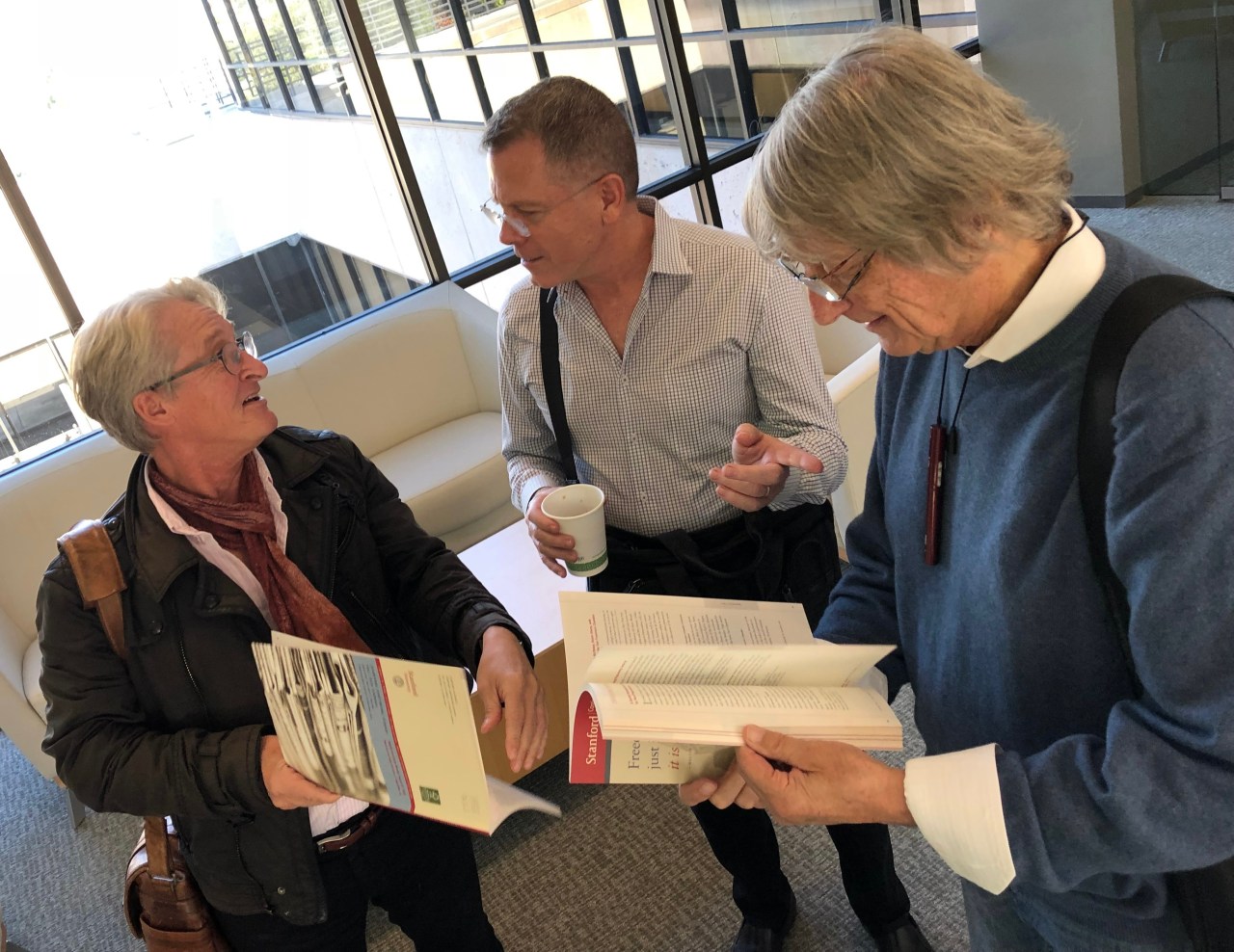
Photos courtesy of Chris Ford.

Stanford d.school with Michael Bell 2017.
Xerox PARC with Michael Bell 2020.
